These scenarios were possible prior to an update to the system which now displays an error message if the same VIN or Number is used to add a Tractor.
Now that we have an idea of how a duplicate Tractor entry could have occurred, let's remedy the situation by removing those duplicates. Please use the following instructions to remove duplicate Tractors by deactivation.
[post_title] => Avoiding Duplicate Assets
[post_excerpt] =>
[post_status] => publish
[comment_status] => closed
[ping_status] => closed
[post_password] =>
[post_name] => avoiding-duplicate-assets
[to_ping] =>
[pinged] =>
[post_modified] => 2023-06-29 12:19:26
[post_modified_gmt] => 2023-06-29 19:19:26
[post_content_filtered] =>
[post_parent] => 0
[guid] => https://help.gpsinsight.com/?post_type=documentation&p=27543
[menu_order] => 0
[post_type] => documentation
[post_mime_type] =>
[comment_count] => 0
[filter] => raw
)
[1] => WP_Post Object
(
[ID] => 27320
[post_author] => 12
[post_date] => 2023-06-01 08:38:50
[post_date_gmt] => 2023-06-01 15:38:50
[post_content] => The ELD Complete solution supports Bring Your Own Device (BYOD) via Bluetooth. Drivers can download the GPS Insight ELD Complete app (Android and iOS compatible) to their mobile device from the
. The BYOD solution requires a
We recommend keeping a sticker, or card, in the vehicle with the serial number of the installed GPS device for easy reference during future driver assignments.
[et class="table-zebra" colwidth="50%|50%"]
Android,iOS
Operating System: Minimum O/S 9~~RAM: Minimum 4 GB (Recommended 6+)~~Storage: Minimum 32 GB (Recommended 64+),
Operating System: Minimum O/S 15~~RAM: Minimum 4 GB (Recommended 6+)~~Storage: Minimum 64 GB models (Recommended 128+ GB models)
[/et]
Device Connection
Please use the link below for instructions on connecting your device to the ELD Complete application.
Fuel Receipts
Using the Fuel Receipts feature, drivers to take a picture of a fuel receipt and share it with admin personnel by uploading it from the ELD Complete App. Captured data includes fuel type, reference no., gallons, total cost, vehicle name (from vehicle profile), odometer value (from ECM), date, time, address, and notes. This information is available in the ELD Complete Admin Portal from the Fuel Receipts tab. Reports can be downloaded in Excel format.
You can search fuel receipts by:
- Units
- Driver
- Carrier (Multiple carrier accounts)
- Fuel type
- Terminal
- Region

Editing Fuel Receipts
Fuel receipts uploaded to the Portal can be edited and/or deleted.
How to edit a fuel receipt:

- From the Fuel Receipts tab, use the filter/search options to locate the fuel receipt you would like to edit.
- Under the Actions column corresponding to the row of the applicable receipt, click the Edit icon (
 ).
The Edit Fuel Receipts pop-up appears. Available edits include:
- Make your edits and click Save.
A green pop-up appears in the top-right corner confirming the edit was successfully saved.
Deleting Fuel Receipts
How to delete a fuel receipt:
- From the Fuel Receipts tab, use the filter/search options to locate the fuel receipt you would like to edit.
- Under the Actions column corresponding to the row of the applicable receipt, click the Delete icon (
 ).
A pop-up appears asking you to confirm you would like to delete the receipt.
- Click OK to delete the receipt or click Cancel to exit without deleting.
A green pop-up appears in the top-right corner confirming the receipt was successfully deleted.
Driver Documents
Drivers can upload documents and photos via the BYOD solution. The uploaded docs/photos are accessible on the ELD Complete Admin Portal via the Drivers page.
How to access driver documents:
- From the ELD Complete Admin Portal, click Manage.
- Use the drop-down under name to select the Carrier.
- Under ACTIONS, select Drivers.
 The list of drivers associated to the selected carrier is displayed.

- Click Driver Documents (
 ).
The Driver Documents pop-up appears.

- Click the applicable button under actions (Download, Edit, Delete) for the applicable document to perform your task.
You can also add a document to the driver's documents by clicking +New.
[post_title] => Bring Your Own Device (BYOD)
[post_excerpt] =>
[post_status] => publish
[comment_status] => closed
[ping_status] => closed
[post_password] =>
[post_name] => bring-your-own-device-byod
[to_ping] =>
[pinged] =>
[post_modified] => 2024-09-26 06:17:17
[post_modified_gmt] => 2024-09-26 13:17:17
[post_content_filtered] =>
[post_parent] => 0
[guid] => https://help.gpsinsight.com/?post_type=documentation&p=27320
[menu_order] => 0
[post_type] => documentation
[post_mime_type] =>
[comment_count] => 0
[filter] => raw
)
[2] => WP_Post Object
(
[ID] => 26444
[post_author] => 12
[post_date] => 2023-01-11 14:38:52
[post_date_gmt] => 2023-01-11 21:38:52
[post_content] => When reviewing the Driver Records report in ELD Complete, certain columns contain specific codes directly relating to the FMCSA’s Final Rule.
 To make it easier to decipher these events, please refer to the charts below for what each code value represents.
Event Record Status Codes
[et class="table-zebra" colwidth="25%|75%"]
Code,Description
1,Active
2,Inactive - Changed
3,Inactive - Change Requested
4,Inactive - Change Rejected
[/et]
Event Record Origin Codes
[et class="table-zebra" colwidth="25%|75%"]
Code,Description
1,Automatically recorded by ELD
2,Edited or entered by the driver
3,Edit requested by an authenticated user other than the driver
4,Assumed from unidentified driver profile
[/et]
Event Type Parameter Codes
[et class="table-zebra" colwidth="10%|10%|80%"]
Type,Code,Description
1,1,Driver's duty status changed to "off-duty"
1,2,Driver's duty status changed to "sleeper-berth"
1,3,Driver's duty status changed to "driving"
1,4,Driver's duty status changed to "on-duty not driving"
2,1,Intermediate log with conventional location precision
2,2,Intermediate log with reduced location precision
3,1,Driver indicates "authorized personal use of CMV"
3,2,Driver indicates "yard moves"
3,0,Driver indication for PC\, YM\, and WT cleared
4,1,Driver's first certification of a daily record
4,n,Driver's n'th certifcation of a daily record (when recertification is necessary)~~~~"n" is an integer between 1 and 9. If more than 9 certifications is needed\, use 9 for each new re-certification record.
5,1,Authenticated driver's ELD login activity
5,2,Authenticated driver's ELD logout activity
6,1,Engine power-up with conventional location precision
6,2,Engine power-up with reduced location precision
6,3,Engine shut-down with conventional location precision
6,4,Engine shut-down with reduced location precision
7,1,An ELD malfunction logged
7,2,An ELD malfunction cleared
7,3,A data diagnostic event logged
7,4,A data diagnostic event cleared
[/et]
Malfunction/Diagnostic Codes
[et class="table-zebra" colwidth="25%|75%"]
Code,Description
P,Power Compliance malfunction
E,Engine synchronization compliance malfunction
T,Timing compliance malfunction
L,Positioning compliance malfunction
R,Data recording compliance malfunction
S,Data transfer compliance malfunction
O,Other ELD detected malfunction
1,Power data diagnostic event
2,Engine synchronization data diagnostic event
3,Missing required data elements data diagnostic event
4,Data transfer data diagnostic event
5,unidentified driving records data diagnostic event
6,Other ELD identified diagnostic event
[/et]
[post_title] => Driver Record Event Codes
[post_excerpt] =>
[post_status] => publish
[comment_status] => closed
[ping_status] => closed
[post_password] =>
[post_name] => driver-record-event-codes
[to_ping] =>
[pinged] =>
[post_modified] => 2023-02-08 11:50:40
[post_modified_gmt] => 2023-02-08 18:50:40
[post_content_filtered] =>
[post_parent] => 0
[guid] => https://help.gpsinsight.com/?post_type=documentation&p=26444
[menu_order] => 0
[post_type] => documentation
[post_mime_type] =>
[comment_count] => 0
[filter] => raw
)
[3] => WP_Post Object
(
[ID] => 26469
[post_author] => 12
[post_date] => 2023-01-24 08:21:16
[post_date_gmt] => 2023-01-24 15:21:16
[post_content] => The Driver Records Portal tab allows you to run a report on all driver-duty changes made on a driver log. This report can be run for all drivers or a specific driver at a time.
When reviewing the Driver Records report in ELD Complete, certain columns contain specific codes directly relating to the FMCSA’s Final Rule. Please see Driver Record Event Codes for a list of values and corresponding descriptions.

To run the Driver Report:
- In eDash, click the Driver Records tab.
- Select the appropriate company from the Carrier dropdown list.
- Select the appropriate Driver from the Drivers dropdown list.
- Select the date range you would like to view from the calendar.
- Select the Event Status, Event Origin, Event Type, and Event Code from the appropriate dropdown lists.
- Once complete, click Execute.
- The report will appear with the following information:
- ELD
- App Version
- Timestamp
- Driver
- Engine Hours
- Odometer
- New Status
- City
- State
- Latitude
- Longitude
- Status
- Origin
- Type
- Code
- D/M Code
- After reviewing the report, you can export the report to an Excel spreadsheet by click the Excel icon in the top right corner of the report.
[post_title] => Driver Records
[post_excerpt] =>
[post_status] => publish
[comment_status] => closed
[ping_status] => closed
[post_password] =>
[post_name] => driver-records
[to_ping] =>
[pinged] =>
[post_modified] => 2023-01-24 08:21:16
[post_modified_gmt] => 2023-01-24 15:21:16
[post_content_filtered] =>
[post_parent] => 24510
[guid] => https://help.gpsinsight.com/?post_type=documentation&p=26469
[menu_order] => 9
[post_type] => documentation
[post_mime_type] =>
[comment_count] => 0
[filter] => raw
)
[4] => WP_Post Object
(
[ID] => 24510
[post_author] => 12
[post_date] => 2022-11-04 11:19:10
[post_date_gmt] => 2022-11-04 18:19:10
[post_content] => The ELD Complete portal provides the ability to administer drivers (add, delete, and monitor), review and edit logs, and run reports. The portal and device stay synchronized to provide a nearly real-time view of your fleet.
Once you are logged in to ELD Complete, you are brought to the home screen of the portal with setup options, administrator tabs, and eDash links. All portal and reporting features are found in eDash.
To access eDash:
- Hover over the eDash tab and click HOS + DVIR.
- On the HOS + DVIR page, you'll see the following tabs:
- Manage: The Manage tab allows you to view and edit carrier details, including profile settings, drivers, home bases, assets, and notifications.
- Log Books: The Log Books tab gives you the ability to view all of your driver’s daily driving log details. This tab also allows you to download, view and print records as needed, along with exporting ELD data files for troubleshooting purposes or FMCSA regulations.
- Unidentified Logs: The Unidentified Logs tab provides logs of drive times that are not associated with or captured by a specific driver. This tab allows you to assign these drive times and trips to the correct driver.
- Log Edits: The Log Edits tab allows you to view edited logs and can be filtered by carrier, status (active, inactive, or all), drivers, date (up to a month), and log status (All, Assumed, Requested, and Rejected).
- Dashboard: The Dashboard tab provides an overview of compliance and HOS details and can be filtered by carrier.
- Violations: The Violations tab provides a list of violations your drivers have received through ELD Complete.
- DVIR: The Driver-Vehicle Inspection Report (DVIR) tab allows you to view all DVIRs completed by your drivers.
- IFTA Tab: The IFTA tab allows you to run IFTA reports for each vehicle in your organization. This report helps you keep track of miles traveled and fuel purchased in each state. This is helpful for companies that file quarterly IFTA or fuel tax reports. These reports are run by year, quarter and month.
- Driver Records: The Driver Records tab allows you to run a report on all driver-duty changes made on a driver log. This report can be run for all drivers or a specific driver at a time.
- FMCSA Records Report: The FMCSA Records report provides a list of all records that have been sent to the FMCSA upon request. The records that can be requested include driver rides and ECM data. ELD Complete keeps a record of the report types and dates sent to FMCSA.
- Shipments: The Shipments feature allows dispatch or other internal or administrative users to schedule estimated delivery or pickups for their drivers.
- Driver Duty Report: The Driver Duty report tab allows you to run a report that lists how long a driver was in each duty status within a specific date range.
The Engine Diagnostics tab is unavailable by default. This is an add-on feature available at an additional cost. Please contact your Account Manager for additional information if you are interested in learning more.
[post_title] => ELD Complete - Admin Reference Guide
[post_excerpt] =>
[post_status] => publish
[comment_status] => closed
[ping_status] => closed
[post_password] =>
[post_name] => eld-complete-admin-reference-guide
[to_ping] =>
[pinged] =>
[post_modified] => 2023-05-11 07:52:19
[post_modified_gmt] => 2023-05-11 14:52:19
[post_content_filtered] =>
[post_parent] => 0
[guid] => https://help.gpsinsight.com/?post_type=documentation&p=24510
[menu_order] => 0
[post_type] => documentation
[post_mime_type] =>
[comment_count] => 0
[filter] => raw
)
[5] => WP_Post Object
(
[ID] => 26486
[post_author] => 12
[post_date] => 2023-01-24 09:15:13
[post_date_gmt] => 2023-01-24 16:15:13
[post_content] => The Manage tab allows you to view and edit carrier details, including profile settings, drivers, home bases, assets, and notifications.
Multi Operating Authority
The Multi Operating Authority is a hierarchy structure offering the ability to manage multiple Carriers, Drivers, Home Bases and Assets. For example, a driver account assigned to an MOA account, can operate under any Carrier belonging to that MOA account and choose any assets as well under that MOA account.
 Once you have selected an Multi Operating Authority by clicking Multi Operating Authority and selecting the applicable carrier, available actions include:
- View Details
- Drivers
- Home Bases
- Assets
- Notifications
Managing Carrier Details
To manage carrier details:
- In eDash, click the Manage tab.
- Select the appropriate company name from the dropdown list/
- Under actions, select one of the following options:
- Details (
 )
- Drivers (
 )
- Home Bases (
 )
- Assets (
 )
- Notifications (
 )
Editing Carrier Details
To edit carrier details:
- Click the Details () icon.
- The carrier window will appear, displaying the following editable options:
- Carrier Name
- Carrier Address
- Carrier Country
- Time Zone
- Units
- Support Username
- Support Password (this field is not editable)
- Confirm Password (this field is not editable)
- API Key
- Addtional checkboxes
- Once you've made your edits, click Save, then Close

Editing Drivers
To edit drivers:
- Click the Drivers () icon.
A list of drivers will appear.
- In the Drivers - Active column, click the checkbox to activate and deactivate drivers.
- In the Drivers - Actions column, click Driver Details to edit driver information, including:
- (First) Name
- Last Name
- Username (this field is not editable)
- Password (this field is not editable)
- Confirmation (this field is not editable)
- Home Base: Select a headquarters for your driver in the dropdown menu
- Ruleset*
- 24-Period Starting Time
- Driver specific checkboxes, including Active, Personal Use, Yard Move, and Exemption.
- Units
- Registration State
- License Number
- DVIR and Exemption checkboxes, including DVIR Wifi Only, Allow to use Exemption, Allow to take DVIR photo
Available exemptions:
- No logs for Agricultural Operations - 395.1(k)
- Driver-salesperson whose total driving time does not exceed 40 hours in any period of 7 consecutive days - 395.1(c)
- Relief from All Driving Rules for Emergency Conditions - 395.1(b)(2)
- No Logs for Construction Equipment operating within 50-mile radius - 221.025 (8)
- No Logs for Non-Commercial Motor Vehicle
- No Logs for CDL short-haul Drivers operating within 150 air miles (14 hour shift) - 395.1(e)(1)
- No Logs for short-haul Asphalt or Ready-Mixed Concrete Drivers operating within 100 air miles
395(e)(1) or Non-CDL drivers operating within 150 air miles 395(e)(2)
- Relief from Driving rules for State of Emergency - 390.23
- Relief from All Driving Rules for Utility Service Vehicles - 395.1(n)
- Custom reason
- Once you've made your edits, click Save, then Close

Managing Home Bases
To manage home bases:
- Click the Home Bases () icon.
- To create a new base, click New in the right corner of the Home Bases tab.
The Home Base window will appear.
- Enter the appropriate information in the following fields:
- Location Name
- Address
- Latitude
- Longitude
- Time Zone
- Once entered, click Save, then Close.
- In the Home Bases - Actions column, click the Details icon to edit home base information.
- In the same column, click the Driver Assignment icon to assign specific drivers to the home base location.

Managing Assets
To manage assets:
- Click the Assets () icon.
- To add a new asset, click New in the right corner of the Assets tab.
The Asset window will appear.
- Enter the appropriate information in the following fields:
- Asset Type
- Fuel Type Primary
- Number
- Make
- VIN (Optional for trailers only)
- Model
- Plate (Optional for tractors and trailers only)
- Year
- Registration State
- Type
- Body Class
- GVWR
- Description (Optional)
- ECM Identifier (Only required if Force Asset or ECM-Device are selected)
- Addtional ECM Identifier (Optional)
- Once complete, click Save, then Close
- In the Assets - Actions column, click the details icon to edit asset information.

Managing Notification Settings
To manage notifications:
- Click the Notifications () icon.
- To set a new notification, click New in the top right corner of the Notification tab.
The Notification window will appear.
- Enter the appropriate information in the following fields:
- Home Base: Select a place of business in the dropdown menu.
- Name: Enter a name/description for the notification.
- Type: Select the notification type from the drop down menu.
- Emails: Enter the emails of the recipients you would like to send the notification to. (Separate emails by comma)
- Drivers: Select the drivers who will receive the notification.
- Once complete, click Save, then Close

[post_title] => Managing Carrier Details & Settings
[post_excerpt] =>
[post_status] => publish
[comment_status] => closed
[ping_status] => closed
[post_password] =>
[post_name] => managing-carrier-details-settings
[to_ping] =>
[pinged] =>
[post_modified] => 2023-07-28 16:23:50
[post_modified_gmt] => 2023-07-28 23:23:50
[post_content_filtered] =>
[post_parent] => 24510
[guid] => https://help.gpsinsight.com/?post_type=documentation&p=26486
[menu_order] => 1
[post_type] => documentation
[post_mime_type] =>
[comment_count] => 0
[filter] => raw
)
[6] => WP_Post Object
(
[ID] => 26501
[post_author] => 12
[post_date] => 2023-01-24 09:35:01
[post_date_gmt] => 2023-01-24 16:35:01
[post_content] => The Shipments feature allows dispatch or other internal or administrative users to schedule estimated delivery or pickups for their drivers. When shipments are scheduled and assigned to a driver, the driver is notified and can view all details of the trip, including scheduled deliveries and pickups. A Shipments report is also available to list previously scheduled shipments and their details.
Viewing Scheduled Shipments
To view scheduled shipments:

- In eDash, click the Shipments tab.
- Select the appropriate company from the Carrier dropdown list.
- Select the appropriate driver from the Drivers dropdown list.
- Select the date range you would like to view from the calendar.
- Once complete, click Execute.
Creating New Shipments
To create a new shipment:

- In the Shipments tab, click New.
The Shipment Details window will appear.

- Enter the appropriate information in the following required fields:
- Estimated Pickup (Date)
- Estimated Delivery (Date)
- Driver
- From here, all additional fields are optional.
- Once complete, click Save.
[post_title] => Managing Shipments
[post_excerpt] =>
[post_status] => publish
[comment_status] => closed
[ping_status] => closed
[post_password] =>
[post_name] => managing-shipments
[to_ping] =>
[pinged] =>
[post_modified] => 2023-01-24 09:35:01
[post_modified_gmt] => 2023-01-24 16:35:01
[post_content_filtered] =>
[post_parent] => 24510
[guid] => https://help.gpsinsight.com/?post_type=documentation&p=26501
[menu_order] => 11
[post_type] => documentation
[post_mime_type] =>
[comment_count] => 0
[filter] => raw
)
[7] => WP_Post Object
(
[ID] => 26477
[post_author] => 12
[post_date] => 2023-01-24 08:42:40
[post_date_gmt] => 2023-01-24 15:42:40
[post_content] => The Unidentified Logs tab provides logs of drive times that are not associated with or captured by a specific driver. This tab allows you to assign these drive times and trips to the correct driver.
To view unidentified logs:
- In eDash, click the Unidentified Logs tab.
- Select your company from the Carrier dropdown list.
- Select the status (Active, Inactive or All) from the Status dropdown list.
- Select the appropriate vehicles, or select All, from the Vehicle dropdown list.
- Select the date you would like to view from the calendar.
- Once complete, click Execute.
- The unidentifed log results will display the following information:
- Timestamps
- Event Status
- Odometer
- Miles
- Status
- Remarks
- If the unidentified log was captured by the driver, the status will say Assumed.
- If the unidentified log was not captured by a driver, the status will say Active and will need to be accepted by the responsible driver.
- Be sure to notify the appropriate driver associated with the vehicle and time of the unidentified log.
- Once the driver assumes responsibility for the unidentified log, the log will be added to their log book, and the status will be updated to Assumed.

[post_title] => Managing Unidentified Logs
[post_excerpt] =>
[post_status] => publish
[comment_status] => closed
[ping_status] => closed
[post_password] =>
[post_name] => managing-unidentified-logs
[to_ping] =>
[pinged] =>
[post_modified] => 2023-05-10 12:19:59
[post_modified_gmt] => 2023-05-10 19:19:59
[post_content_filtered] =>
[post_parent] => 24510
[guid] => https://help.gpsinsight.com/?post_type=documentation&p=26477
[menu_order] => 3
[post_type] => documentation
[post_mime_type] =>
[comment_count] => 0
[filter] => raw
)
[8] => WP_Post Object
(
[ID] => 27289
[post_author] => 12
[post_date] => 2023-08-18 08:20:50
[post_date_gmt] => 2023-08-18 15:20:50
[post_content] => You can add, edit, and delete roles, users, and Multi Operating Authorities via the Administration menu in the Admin Portal.

Managing Roles
From the Roles tab of the ELD Complete Admin Portal, you can view, search, add, edit and delete roles.

Adding Roles
You can add a role with selected permissions.
How to add a role:
- From the Roles tab, click +New.
The Add Role form appears.
- Use the Carrier dropdown to select a carrier.
- In the Name field, enter a name for the role.
- In the Permission List section, use the checkboxes to select the permissions for the role.
- Click Save.
The new role is added to the list of roles.
Editing a Role
You can make changes to a role using the Edit button.
How to edit a role:
- From the Roles tab, locate the role you would like to edit and click Edit Role (
 ).
- Make your edits to either the role name or the selected permissions.
You cannot edit the selected carrier for the role.
- Click Save.
A pop-up with green text appears at the top-right corner of the browser tab to confirm your changes have been saved successfully.
Deleting a Role
You can delete a role using the Delete Role button.
- From the Roles tab, locate the role you would like to edit and click Delete Role (
 ).
The Please Confirm pop-up appears asking: "Are you sure you want to delete the role?"
- Click OK.
A pop-up with green text appears at the top-right corner of the browser tab to confirm the role has been deleted successfully.
Managing Users
From the Users tab of the ELD Complete Admin Portal, you can view, search, filter (by carrier and/or MOA), add, edit and delete users.
 You can easily search or filter the users listed on this tab by using the search field and/or the Carrier and/or MOA drop-down filters.

Adding a User
How to add a user:
- From the Users tab, click +New.
The Add User form appears.
- Click appropriate radio button for user option: Reseller User, Carrier User, App Support.
The App Support user can only work in the App to configure the ELD. This user can be created by any user who has access to the web administration. User type available for App Support are MOA or Carrier, and in both cases, the user can be limited by home bases or given access to all home bases.
- Complete the form (* denotes required field).
The available/required fields vary depending on which user option is selected.
- Click Save.
A pop-up with green text appears at the top-right corner of the browser tab to confirm the user has been added successfully.The newly created user appears in the list of users.
Editing a User
How to edit a user:
- From the Users tab, locate the user you would like to edit and click Edit User ().
The Edit User pop-up appears.
- Make your edits to the available fields as needed and click Save.
You cannot edit the username at this time.
A pop-up with green text appears at the top-right corner of the browser tab to confirm the user has been edited successfully.
Deleting a User
How to delete a user:
- From the Users tab, locate the user you would like to delete and click Delete Role ().
The Please Confirm pop-up appears asking: "Are you sure you want to delete the user?"
- Click OK.
A pop-up with green text appears at the top-right corner of the browser tab to confirm the user has been deleted successfully.
Managing Multi Operating Authorities
From the MOA (Multi Operating Authority) tab of the ELD Complete Admin Portal, you can view, search, add, edit and delete an MOA.
 MOAs are listed by name and number of carriers. Use the search field to easily locate an MOA from the list.
Adding an MOA
How to add an MOA:
- From the MOA tab, click +New.
The Add MOA form appears.
- Enter a name.
You can add carriers to the MOA from the Manage tab.
- Click Save.
A pop-up with green text appears at the top-right corner of the browser tab to confirm the MOA has been added successfully.
Editing an MOA
How to edit an MOA:
- From the MOA tab, locate the user you would like to edit and click Edit MOA ().
The Edit Multi Operating Authority form appears.
- Edit the name.
You can only edit the name of the MOA here. To make other changes, use the Manage tab.
- Click Save.
A pop-up with green text appears at the top-right corner of the browser tab to confirm the MOA has been edited successfully.
Deleting an MOA
How to delete an MOA:
- From the MOA tab, locate the user you would like to delete and click Delete MOA ().
You cannot delete an MOA that is in use.
[post_title] => Role & User Administration
[post_excerpt] =>
[post_status] => publish
[comment_status] => closed
[ping_status] => closed
[post_password] =>
[post_name] => role-user-administration
[to_ping] =>
[pinged] =>
[post_modified] => 2023-08-18 08:20:50
[post_modified_gmt] => 2023-08-18 15:20:50
[post_content_filtered] =>
[post_parent] => 24510
[guid] => https://help.gpsinsight.com/?post_type=documentation&p=27289
[menu_order] => 0
[post_type] => documentation
[post_mime_type] =>
[comment_count] => 0
[filter] => raw
)
[9] => WP_Post Object
(
[ID] => 26507
[post_author] => 12
[post_date] => 2023-01-24 09:44:48
[post_date_gmt] => 2023-01-24 16:44:48
[post_content] => Each of the available tabs in the Portal offers the ability to run and print reports.
Running Reports
To run reports in ELD Complete:
- Select the tab or feature you want to work with.
- Select the driver or vehicle depending on the feature you're working with
- Enter all details - company, driver name, activity, and/or date.
- Click the Execute link to run the report.
- The report results will appear on the same screen.
Available Report
Odometer Jump Report
This report allows carriers to obtain a list of events in which odometer value has jumped. The report shows driver, status, location, odometer value, and date/time stamp data before the odometer jump and after the odometer jump. You can sort the report using the sort feature for each column to sort in ascending or descending order.
By default, the “Include Missing Values” option is unchecked. Once that option is selected, the scenario with zero Odometer value will be added to the report.
 [post_title] => Running Reports
[post_excerpt] =>
[post_status] => publish
[comment_status] => closed
[ping_status] => closed
[post_password] =>
[post_name] => running-reports
[to_ping] =>
[pinged] =>
[post_modified] => 2023-07-26 08:12:27
[post_modified_gmt] => 2023-07-26 15:12:27
[post_content_filtered] =>
[post_parent] => 24510
[guid] => https://help.gpsinsight.com/?post_type=documentation&p=26507
[menu_order] => 13
[post_type] => documentation
[post_mime_type] =>
[comment_count] => 0
[filter] => raw
)
[10] => WP_Post Object
(
[ID] => 26504
[post_author] => 12
[post_date] => 2023-01-24 09:37:40
[post_date_gmt] => 2023-01-24 16:37:40
[post_content] => The Driver Duty report tab allows you to run a report that lists how long a driver was in each duty status within a specific date range.
To view a driver duty report:
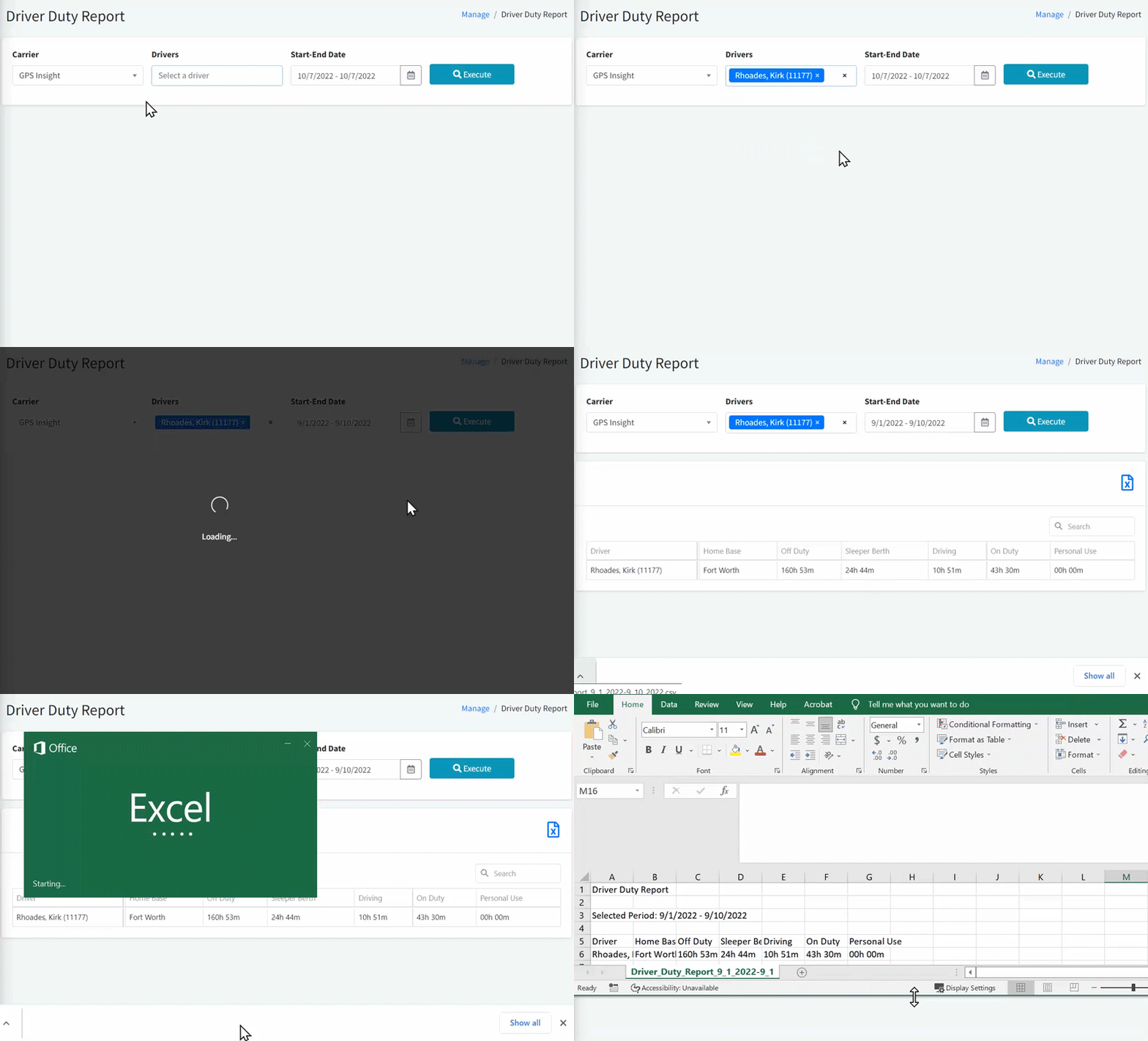
- In eDash, click the Driver Duty Report tab.
- Select the appropriate company from the Carrier dropdown list.
- Select the appropriate driver from the Drivers dropdown list.
- Select the date range you would like to view from the calendar.
- Once complete, click Execute.
The Driver Duty Report displays the following information:
- Driver
- Home Base
- Off Duty (Total in hh/mm)
- Sleeper Berth (Total in hh/mm)
- Driving (Total in hh/mm)
- On Duty (Total in hh/mm)
- Personal Use (Total in hh/mm)
- If you would like to export the report to .xls format, click the .xsl icon.
The exported report is downloaded as a .xls file.
[post_title] => Running the Driver Duty Report
[post_excerpt] =>
[post_status] => publish
[comment_status] => closed
[ping_status] => closed
[post_password] =>
[post_name] => running-the-driver-duty-report
[to_ping] =>
[pinged] =>
[post_modified] => 2023-01-24 09:37:40
[post_modified_gmt] => 2023-01-24 16:37:40
[post_content_filtered] =>
[post_parent] => 24510
[guid] => https://help.gpsinsight.com/?post_type=documentation&p=26504
[menu_order] => 12
[post_type] => documentation
[post_mime_type] =>
[comment_count] => 0
[filter] => raw
)
[11] => WP_Post Object
(
[ID] => 26498
[post_author] => 12
[post_date] => 2023-01-24 09:32:30
[post_date_gmt] => 2023-01-24 16:32:30
[post_content] => The FMCSA Records report provides a list of all records that have been sent to the FMCSA upon request. The records that can be requested include driver rides and ECM data. ELD Complete keeps a record of the report types and dates sent to FMCSA.
To run the FMCSA Records report:

- In eDash, click the FMCSA Records tab
- Select the appropriate company from the Carrier dropdown list.
- Select the appropriate driver or all drivers from the Drivers dropdown list.
- Select the date range you would like to view from the calendar.
- Once complete, click Execute.
[post_title] => Running the FMCSA Records Report
[post_excerpt] =>
[post_status] => publish
[comment_status] => closed
[ping_status] => closed
[post_password] =>
[post_name] => running-the-fmcsa-records-report
[to_ping] =>
[pinged] =>
[post_modified] => 2023-01-24 09:32:30
[post_modified_gmt] => 2023-01-24 16:32:30
[post_content_filtered] =>
[post_parent] => 24510
[guid] => https://help.gpsinsight.com/?post_type=documentation&p=26498
[menu_order] => 10
[post_type] => documentation
[post_mime_type] =>
[comment_count] => 0
[filter] => raw
)
[12] => WP_Post Object
(
[ID] => 27538
[post_author] => 12
[post_date] => 2023-06-23 08:59:12
[post_date_gmt] => 2023-06-23 15:59:12
[post_content] => If you are a customer who requires an HOS/ELD solution and you are interested in our ELD Complete offering, please use the steps below to begin your enrollment.
Beginning the Process
Let's get you on your way to receiving the benefits of ELD Complete with the below initial steps.
How to sign up for ELD Complete:
- Contact your Customer Success Representative to sign up for the ELD Complete Product.
- Sign the estimate to begin your ELD Complete service.
Once your estimate has been signed, you will receive an email detailing how to complete your ELD account setup and your credentials to log in to ELD Complete.
[post_title] => Signing Up for ELD Complete
[post_excerpt] =>
[post_status] => publish
[comment_status] => closed
[ping_status] => closed
[post_password] =>
[post_name] => signing-up-for-eld-complete
[to_ping] =>
[pinged] =>
[post_modified] => 2025-01-24 12:46:33
[post_modified_gmt] => 2025-01-24 19:46:33
[post_content_filtered] =>
[post_parent] => 0
[guid] => https://help.gpsinsight.com/?post_type=documentation&p=27538
[menu_order] => 0
[post_type] => documentation
[post_mime_type] =>
[comment_count] => 0
[filter] => raw
)
[13] => WP_Post Object
(
[ID] => 32977
[post_author] => 12
[post_date] => 2025-08-08 11:23:06
[post_date_gmt] => 2025-08-08 18:23:06
[post_content] =>
Use the following instructions to switch a tablet from a wired (serial) connection to a Bluetooth connection for a Bring Your Own Device (BYOD) option.
Note: The tablet or mobile device must have access to the Google Play Store or Apple App Store to download the application. If you have already accessed the stores and installed the ELD Complete app, you may proceed to Step 3.
- Confirm the tablet or mobile device is compatible with Google Play or App Store (IOS/Apple).
- Confirming Google Play (Android) Compatibility:
- In a browser tab, navigate to Google Play supported devices - Google Play Help.
- From the list of Supported Android devices, search for the device details by the following:
- Retail Branding
- Marketing Name
- Device
- Model
- If the device appears in the list, it is compatible with Google Play.
- Confirming App Store (iOS) Compatibility:
- In a browser tab, navigate to Official Apple Support.
- Check the device model:
- On the device, navigate to Settings > General > About.
- Locate the device's Model Name and Software Version.
- Cross-reference the Model Name and Software Version against the list of supported devices provided on the Official Apple Support site.
- If the device appears in the list, it is compatible with the App Store (iOS).
- Download the ELD Complete app from the Google Play or Apple Store (depending on your device's compatibility).
- Obtain your GPS tracking device's serial number and be ready to provide it while contacting GPS Insight Support in the next step.
- Contact GPS Insight Support and provide your GPS tracking device's serial number to confirm that the correct device(s) is/are switched to Bluetooth mode.
Note: The Messaging app on a serial tablet can provide the device's serial number.
- Start the vehicle, ignition ON status, to ensure the GPS device is awake and broadcasting a Bluetooth signal.
- Connect the BYOD device to the ELD Complete solution using the reference materials listed below:
- Mount the BYOD device following the mounting requirements provided below:
- Fixed Position While Driving:
- The ELD must be mounted in a fixed position during vehicle operation.
- The ELD must be visible to the driver from a normal seated position while wearing a seatbelt.
- FMCSA & Transport Canada Rules:
[post_title] => Switching from Serial to Bluetooth (BYOD)
[post_excerpt] =>
[post_status] => publish
[comment_status] => closed
[ping_status] => closed
[post_password] =>
[post_name] => switching-from-serial-to-bluetooth-byod
[to_ping] =>
[pinged] =>
[post_modified] => 2025-08-21 12:43:07
[post_modified_gmt] => 2025-08-21 19:43:07
[post_content_filtered] =>
[post_parent] => 0
[guid] => https://help.gpsinsight.com/?post_type=documentation&p=32977
[menu_order] => 0
[post_type] => documentation
[post_mime_type] =>
[comment_count] => 0
[filter] => raw
)
[14] => WP_Post Object
(
[ID] => 26483
[post_author] => 12
[post_date] => 2023-01-24 09:09:42
[post_date_gmt] => 2023-01-24 16:09:42
[post_content] => The Dashboard tab provides an overview of compliance and HOS details and can be filtered by carrier.
Viewing Compliance Details
To view Compliance details:
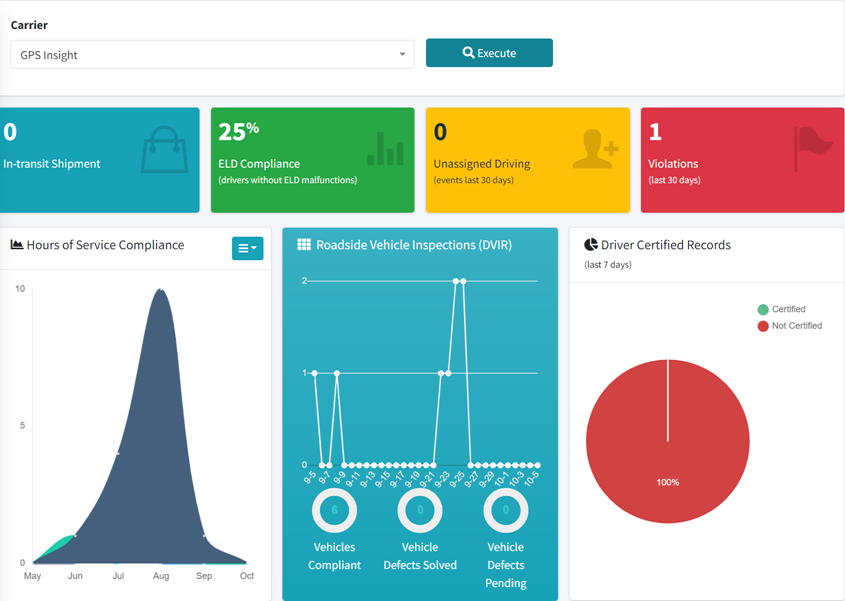
- In eDash, click the Dashboard tab then Compliance.
- Select the carrier from the dropdown menu, then click Execute.
- In-transit Shipment
- ELD Compliance
- Unassigned Driving
- Violations
- Hours of Service Compliance
- Roadside Vehicle Inspections (DVIR)
- Driver Certified Records
Viewing HOS Options
Hours of Service options:

- In eDash, click the Dashboard tab then Hours of Service.
- Select the appropriate company in the Carrier field.
- Select a specific driver or All (to view all drivers) in the Drivers field.
- Once complete, click Execute.
- The results will display the following information:
- Driver
- Home Base
- Ruleset
- Driving Hours
- OnDuty Hours
- Cycle OnDuty
- Next 30 Minutes Break
- Current Status
- Last Position
- Last Update
- If all entries are green, the driver is in good standing and in their appropriate worktime window.
- If an entry is yellow, the driver is within one hour of going over their allotted time.
- If an entry is red, the driver is in compliance error and needs to pull over as soon as possible.
[post_title] => Using the Dashboard
[post_excerpt] =>
[post_status] => publish
[comment_status] => closed
[ping_status] => closed
[post_password] =>
[post_name] => using-the-dashboard
[to_ping] =>
[pinged] =>
[post_modified] => 2023-01-24 09:09:42
[post_modified_gmt] => 2023-01-24 16:09:42
[post_content_filtered] =>
[post_parent] => 24510
[guid] => https://help.gpsinsight.com/?post_type=documentation&p=26483
[menu_order] => 5
[post_type] => documentation
[post_mime_type] =>
[comment_count] => 0
[filter] => raw
)
[15] => WP_Post Object
(
[ID] => 26495
[post_author] => 12
[post_date] => 2023-01-24 09:30:28
[post_date_gmt] => 2023-01-24 16:30:28
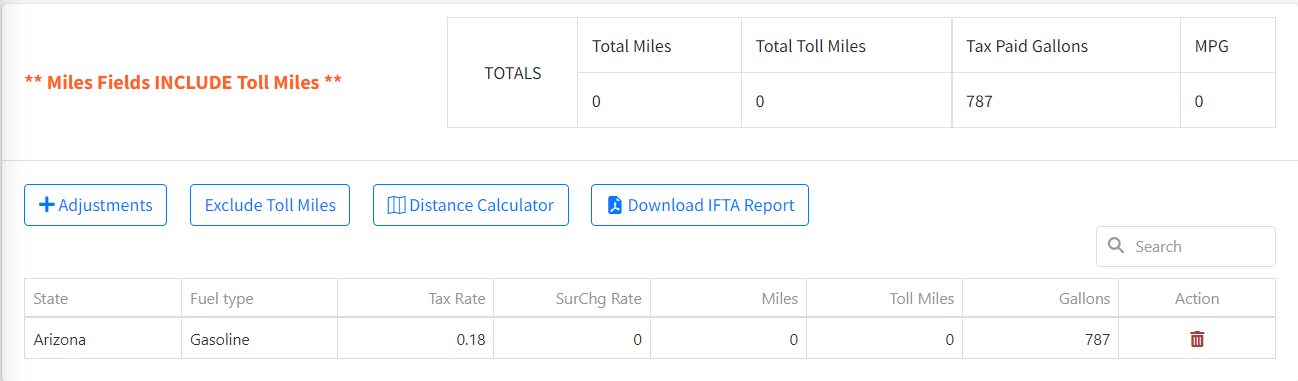
[post_content] => The IFTA tab allows you to run IFTA reports for each vehicle in your organization. This report helps you keep track of miles traveled and fuel purchased in each state. This is helpful for companies that file quarterly IFTA or fuel tax reports. These reports are run by year, quarter and month.
To view IFTA reports:
- In eDash, click the IFTA tab.
- Select the appropriate year, quarter or month from the appropriate dropdown lists.
- Select the region from the dropdown list.
- Select the carrier from the dropdown list.
- Select the appropriate vehicle from the dropdown list.
- Once complete, click Execute.

- The report will appear with the following information:
- Jurisdiction
- Total Miles
- Taxable Miles
- MPG
- Taxable Gallons
- Tax Paid Gallons
- Net Taxable Gallons
- Tax Rate
- Tax (Credit) Due
- You can make edits and recalculate the report where necessary.
- Click the Download link at the bottom of the report to download and save for later use.
When a fuel receipt is added, it automatically becomes an adjustment in IFTA.
[post_title] => Using the IFTA Tab
[post_excerpt] =>
[post_status] => publish
[comment_status] => closed
[ping_status] => closed
[post_password] =>
[post_name] => using-the-ifta-tab
[to_ping] =>
[pinged] =>
[post_modified] => 2023-07-26 08:07:23
[post_modified_gmt] => 2023-07-26 15:07:23
[post_content_filtered] =>
[post_parent] => 24510
[guid] => https://help.gpsinsight.com/?post_type=documentation&p=26495
[menu_order] => 8
[post_type] => documentation
[post_mime_type] =>
[comment_count] => 0
[filter] => raw
)
[16] => WP_Post Object
(
[ID] => 26492
[post_author] => 12
[post_date] => 2023-01-24 09:23:58
[post_date_gmt] => 2023-01-24 16:23:58
[post_content] => The Driver-Vehicle Inspection Report (DVIR) tab allows you to view all DVIRs completed by your drivers.

To view DVIRs:
- In eDash, click the DVIR tab.
- Select your company from the Carrier dropdown list.
- Select the status (Active, Inactive or All) from the Status dropdown list.
- Select the appropriate drivers from the Drivers dropdown list.
- Select the date you would like to view from the calendar.
- Click the More Filters toggle to add information to the report, including:
- Tractor Number
- Trailer Number
- Vehicle condition for DVIR
- Report
- Categories
- Defects
- Once complete, click Execute.
- A list of DVIRs will appear with the criteria you selected above.
- The DVIRs have icons at the end of each entry.
- The first icon shows DVIRs without images.
- The second icon shows DVIRs with images taken by the driver. Each DVIR can hold up to 9 images.
- When you click the icons, the DVIR will appear in a new driver window with all details.
[post_title] => Viewing DVIRs
[post_excerpt] =>
[post_status] => publish
[comment_status] => closed
[ping_status] => closed
[post_password] =>
[post_name] => viewing-dvirs
[to_ping] =>
[pinged] =>
[post_modified] => 2023-01-24 09:23:58
[post_modified_gmt] => 2023-01-24 16:23:58
[post_content_filtered] =>
[post_parent] => 24510
[guid] => https://help.gpsinsight.com/?post_type=documentation&p=26492
[menu_order] => 7
[post_type] => documentation
[post_mime_type] =>
[comment_count] => 0
[filter] => raw
)
[17] => WP_Post Object
(
[ID] => 26473
[post_author] => 12
[post_date] => 2023-01-24 08:34:47
[post_date_gmt] => 2023-01-24 15:34:47
[post_content] => The Log Books tab gives you the ability to view all of your driver’s daily driving log details. This tab also allows you to download, view and print records as needed, along with exporting ELD data files for troubleshooting purposes or FMCSA regulations.
Viewing Daily Driver Logs
To view daily driver logs:
- In eDash, click the Log Books tab.
- Select your company from the Carrier dropdown list.
- Select the appropriate region/country from the Region dropdown list.
- Select the status (Active, Inactive or All) from the Status dropdown list.
- Select the appropriate drivers from the Drivers dropdown list.
- Select the date you would like to view from the calendar.
- Once complete, click Execute.
- The driver log results will appear with driver and vehicle details, log grid, and log changes.
- If you see dots on the log grid, you can click on them to view specific details on driver whereabouts.
- Blue Dots: Manual Driver Duty Status Changes
- Black Dots: Automatic ECM Duty Status Changes

Editing Daily Driver Logs
To edit daily driver logs:
- Click the edit icon (
 ) next to the driver duty status at the bottom of the driver's log.
The Edit Log window will appear.
- In the Edit Log window, you can change Status, Start Date, Location, and Remarks.
- Once complete, click Save.

- The driver will receive a notification that you've made a change to their log.
From here, the driver must review the suggested change and approve it.
- If the driver approves the edit, the system will update the change. If declined, the edit will be removed.
ECM Duty Status changes cannot be edited.
Exporting & Printing Multiple Logs
To export and print multiple logs:
- Click Export Print-Display Logs at the top of the driver's log.
 The Export Print-Display Logs window will open.
- Select the Start Date and End Date in the appropriate fields.
- Click Export.

- The selected logs will open in a PDF document that you can download and print.
Exporting ELD Data Files
To export ELD data files:
- Click Export ELD Data File at the top of the driver's log.
 The Export ELD Data File window will open.
- Select the Start Date and End Date in the appropriate fields.
- Enter a comment in the Comment field.
- Select the Appropriate action from the Action dropdown list. Actions include:
- Save: To save the file to a CSV or Excel spreadsheet
- Export to FMCSA: The data file will be sent to FMCSA
- Click Export.

- If you clicked Save in the Actions dropdown list, the file will open in Excel.
[post_title] => Viewing Log Books
[post_excerpt] =>
[post_status] => publish
[comment_status] => closed
[ping_status] => closed
[post_password] =>
[post_name] => viewing-log-books
[to_ping] =>
[pinged] =>
[post_modified] => 2023-01-24 08:34:47
[post_modified_gmt] => 2023-01-24 15:34:47
[post_content_filtered] =>
[post_parent] => 24510
[guid] => https://help.gpsinsight.com/?post_type=documentation&p=26473
[menu_order] => 2
[post_type] => documentation
[post_mime_type] =>
[comment_count] => 0
[filter] => raw
)
[18] => WP_Post Object
(
[ID] => 26480
[post_author] => 12
[post_date] => 2023-01-24 08:57:50
[post_date_gmt] => 2023-01-24 15:57:50
[post_content] => The Log Edits tab allows you to view edited logs and can be filtered by carrier, status (active, inactive, or all), drivers, date (up to a month), and log status (All, Assumed, Requested, and Rejected).
To view log edits:
- In eDash, click the Log Edits tab.
- Select your company from the Carrier dropdown list.
- Select the status (Active, Inactive or All) from the Status dropdown list.
- Select the appropriate vehicles from the Vehicle dropdown list.
- Select the date or date window (up to a month) you would like to view from the calendar.
- Once complete, click Execute.
Edited logs meeting your specifications are displayed.
- The edited log results will display the following information:
- Driver
- Tractor Number
- Timestamp
- Requested Timestamp
- Requested Status
- Requested Location
- Event Status
- Reason

[post_title] => Viewing Log Edits
[post_excerpt] =>
[post_status] => publish
[comment_status] => closed
[ping_status] => closed
[post_password] =>
[post_name] => viewing-log-edits
[to_ping] =>
[pinged] =>
[post_modified] => 2023-01-24 08:57:50
[post_modified_gmt] => 2023-01-24 15:57:50
[post_content_filtered] =>
[post_parent] => 24510
[guid] => https://help.gpsinsight.com/?post_type=documentation&p=26480
[menu_order] => 4
[post_type] => documentation
[post_mime_type] =>
[comment_count] => 0
[filter] => raw
)
[19] => WP_Post Object
(
[ID] => 26489
[post_author] => 12
[post_date] => 2023-01-24 09:20:19
[post_date_gmt] => 2023-01-24 16:20:19
[post_content] => The Violations tab provides a list of violations your drivers have received through ELD Complete.

To view driver violations:
- In eDash, click the Violations tab.
- Select your company from the Carrier dropdown list.
- Select the status (Active, Inactive or All) from the Status dropdown list.
- Select the appropriate drivers from the Drivers dropdown list.
- Select the date you would like to view from the calendar.
- Once complete, click Execute.
- The HOS Violation Report will appear showing violations from all selected drivers.
- Each violation includes the driver's name, user name, date of violation, and the violation type.
- This report can be exported via Excel, PDF, or Word. Simply click the save button at the top of the report and choose your export option.
[post_title] => Viewing Violations
[post_excerpt] =>
[post_status] => publish
[comment_status] => closed
[ping_status] => closed
[post_password] =>
[post_name] => viewing-violations
[to_ping] =>
[pinged] =>
[post_modified] => 2023-01-24 09:20:19
[post_modified_gmt] => 2023-01-24 16:20:19
[post_content_filtered] =>
[post_parent] => 24510
[guid] => https://help.gpsinsight.com/?post_type=documentation&p=26489
[menu_order] => 6
[post_type] => documentation
[post_mime_type] =>
[comment_count] => 0
[filter] => raw
)
)
[post_count] => 20
[current_post] => -1
[before_loop] => 1
[in_the_loop] =>
[post] => WP_Post Object
(
[ID] => 27543
[post_author] => 12
[post_date] => 2023-06-29 12:05:07
[post_date_gmt] => 2023-06-29 19:05:07
[post_content] => You are billed for all Tractors (not Trailers) marked "Active" in your ELD Complete account. To help you avoid being charged twice for the same asset, we are providing the following instructions to deactivate duplicate Tractors. As long as duplicate Tractors are deactivated by midnight the day before the last day of the month, you will not be billed for the duplicate Tractors.
You are not charged for duplicate active Trailers.
How does this occur?
Your account may have duplicate Tractors as a result of the following scenarios:
- The same Tractor was listed more than once on an uploaded spreadsheet.*
- Admins added the same Tractor to the account more than once.*
- Drivers added the same Tractor via tablet.*
- A Tractor is added with the same Number or VIN but the selected Home Base is different.
These scenarios were possible prior to an update to the system which now displays an error message if the same VIN or Number is used to add a Tractor.
Removing Duplicate Tractors
Now that we have an idea of how a duplicate Tractor entry could have occurred, let's remedy the situation by removing those duplicates. Please use the following instructions to remove duplicate Tractors by deactivation.
How to deactivate a duplicate tractor:

- Login to your ELD Complete account and click Manage.
The Manage page appears displaying your Carriers.
- Use the drop-down under Name to select the applicable Carrier by name, then click Assets () under Actions.
The Assets section appears displaying a list of your Tractors and Trailers.
- Use the sort function in the Number column to sort your assets by number.
The list is sorted by number.
- Review your asset list and look for any duplicate numbers. For any duplicates that you find, click the corresponding Details icon (
 ).
The Assets pop-up appears.
- Uncheck the Active checkbox by clicking the checkbox.
You may need to scroll down to locate the checkbox.
The checkbox appears empty.
- Click Save.
The Assets list is displayed and the checkbox under the Active column for the entry row is empty.
- To ensure that you have deactivated all Tractor duplicates for your account, please use the sort function for the VIN column and follow Steps #4-#6.
This process does not need to be performed for Trailers as you are not charged for active Trailers on your account.
[post_title] => Avoiding Duplicate Assets
[post_excerpt] =>
[post_status] => publish
[comment_status] => closed
[ping_status] => closed
[post_password] =>
[post_name] => avoiding-duplicate-assets
[to_ping] =>
[pinged] =>
[post_modified] => 2023-06-29 12:19:26
[post_modified_gmt] => 2023-06-29 19:19:26
[post_content_filtered] =>
[post_parent] => 0
[guid] => https://help.gpsinsight.com/?post_type=documentation&p=27543
[menu_order] => 0
[post_type] => documentation
[post_mime_type] =>
[comment_count] => 0
[filter] => raw
)
[comment_count] => 0
[current_comment] => -1
[found_posts] => 20
[max_num_pages] => 1
[max_num_comment_pages] => 0
[is_single] =>
[is_preview] =>
[is_page] =>
[is_archive] => 1
[is_date] =>
[is_year] =>
[is_month] =>
[is_day] =>
[is_time] =>
[is_author] =>
[is_category] =>
[is_tag] =>
[is_tax] => 1
[is_search] =>
[is_feed] =>
[is_comment_feed] =>
[is_trackback] =>
[is_home] =>
[is_privacy_policy] =>
[is_404] =>
[is_embed] =>
[is_paged] =>
[is_admin] =>
[is_attachment] =>
[is_singular] =>
[is_robots] =>
[is_favicon] =>
[is_sitemap] =>
[is_posts_page] =>
[is_post_type_archive] => 1
[query_vars_hash:WP_Query:private] => 716bd7180fcf9c947b59e32c2adef6e5
[query_vars_changed:WP_Query:private] => 1
[thumbnails_cached] =>
[allow_query_attachment_by_filename:protected] =>
[stopwords:WP_Query:private] =>
[compat_fields:WP_Query:private] => Array
(
[0] => query_vars_hash
[1] => query_vars_changed
)
[compat_methods:WP_Query:private] => Array
(
[0] => init_query_flags
[1] => parse_tax_query
)
[query_cache_key:WP_Query:private] => wp_query:0d811a2d426e41fa1c876a87778e4a3e
)
[children] => Array
(
)
[term] => WP_Term Object
(
[term_id] => 591
[name] => ELD Complete Admin
[slug] => complete-admin
[term_group] => 0
[term_taxonomy_id] => 591
[taxonomy] => feature
[description] => The reference materials in this section are designed for administrators using ELD Complete to monitor their fleets.
[parent] => 0
[count] => 26
[filter] => raw
[term_order] => 2
[cat_ID] => 591
[category_count] => 26
[category_description] => The reference materials in this section are designed for administrators using ELD Complete to monitor their fleets.
[cat_name] => ELD Complete Admin
[category_nicename] => complete-admin
[category_parent] => 0
)
[post_count] => 20
)
)
[video] => Array
(
[591] => Array
(
[posts] => WP_Query Object
(
[query] => Array
(
[orderby] => title
[order] => ASC
[post_type] => video
[posts_per_page] => 999
[tax_query] => Array
(
[0] => Array
(
[taxonomy] => feature
[field] => term_id
[terms] => 591
[include_children] => 1
)
[1] => Array
(
[taxonomy] => solution
[field] => term_id
[terms] => 12
)
[relation] => AND
[2] => Array
(
[taxonomy] => product
[field] => term_id
[terms] => 515
)
)
[meta_query] => Array
(
[0] => Array
(
[key] => _exclude_whitelabel_default
[compare] => NOT EXISTS
)
)
)
[query_vars] => Array
(
[orderby] => title
[order] => ASC
[post_type] => video
[posts_per_page] => 999
[tax_query] => Array
(
[0] => Array
(
[taxonomy] => feature
[field] => term_id
[terms] => 591
[include_children] => 1
)
[1] => Array
(
[taxonomy] => solution
[field] => term_id
[terms] => 12
)
[relation] => AND
[2] => Array
(
[taxonomy] => product
[field] => term_id
[terms] => 515
)
)
[meta_query] => Array
(
[0] => Array
(
[key] => _exclude_whitelabel_default
[compare] => NOT EXISTS
)
)
[error] =>
[m] =>
[p] => 0
[post_parent] =>
[subpost] =>
[subpost_id] =>
[attachment] =>
[attachment_id] => 0
[name] =>
[pagename] =>
[page_id] => 0
[second] =>
[minute] =>
[hour] =>
[day] => 0
[monthnum] => 0
[year] => 0
[w] => 0
[category_name] =>
[tag] =>
[cat] =>
[tag_id] =>
[author] =>
[author_name] =>
[feed] =>
[tb] =>
[paged] => 0
[meta_key] =>
[meta_value] =>
[preview] =>
[s] =>
[sentence] =>
[title] =>
[fields] => all
[menu_order] =>
[embed] =>
[category__in] => Array
(
)
[category__not_in] => Array
(
)
[category__and] => Array
(
)
[post__in] => Array
(
)
[post__not_in] => Array
(
[0] => 14750
[1] => 23436
[2] => 27424
[3] => 27817
[4] => 30225
[5] => 31065
[6] => 31175
[7] => 32017
[8] => 32296
[9] => 32565
[10] => 32605
[11] => 32636
[12] => 33723
[13] => 33737
[14] => 33761
[15] => 34344
[16] => 34459
[17] => 34553
[18] => 34586
[19] => 34590
[20] => 34651
[21] => 34657
[22] => 34659
)
[post_name__in] => Array
(
)
[tag__in] => Array
(
)
[tag__not_in] => Array
(
)
[tag__and] => Array
(
)
[tag_slug__in] => Array
(
)
[tag_slug__and] => Array
(
)
[post_parent__in] => Array
(
)
[post_parent__not_in] => Array
(
)
[author__in] => Array
(
)
[author__not_in] => Array
(
)
[search_columns] => Array
(
)
[ignore_sticky_posts] =>
[suppress_filters] =>
[cache_results] => 1
[update_post_term_cache] => 1
[update_menu_item_cache] =>
[lazy_load_term_meta] => 1
[update_post_meta_cache] => 1
[nopaging] =>
[comments_per_page] => 50
[no_found_rows] =>
[taxonomy] => feature
[term_id] => 591
)
[tax_query] => WP_Tax_Query Object
(
[queries] => Array
(
[0] => Array
(
[taxonomy] => feature
[terms] => Array
(
[0] => 591
)
[field] => term_id
[operator] => IN
[include_children] => 1
)
[1] => Array
(
[taxonomy] => solution
[terms] => Array
(
[0] => 12
)
[field] => term_id
[operator] => IN
[include_children] => 1
)
[relation] => AND
[2] => Array
(
[taxonomy] => product
[terms] => Array
(
[0] => 515
)
[field] => term_id
[operator] => IN
[include_children] => 1
)
)
[relation] => AND
[table_aliases:protected] => Array
(
[0] => wp_term_relationships
[1] => tt1
[2] => tt2
)
[queried_terms] => Array
(
[feature] => Array
(
[terms] => Array
(
[0] => 591
)
[field] => term_id
)
[solution] => Array
(
[terms] => Array
(
[0] => 12
)
[field] => term_id
)
[product] => Array
(
[terms] => Array
(
[0] => 515
)
[field] => term_id
)
)
[primary_table] => wp_posts
[primary_id_column] => ID
)
[meta_query] => WP_Meta_Query Object
(
[queries] => Array
(
[0] => Array
(
[key] => _exclude_whitelabel_default
[compare] => NOT EXISTS
)
[relation] => OR
)
[relation] => AND
[meta_table] => wp_postmeta
[meta_id_column] => post_id
[primary_table] => wp_posts
[primary_id_column] => ID
[table_aliases:protected] => Array
(
[0] => wp_postmeta
)
[clauses:protected] => Array
(
[wp_postmeta] => Array
(
[key] => _exclude_whitelabel_default
[compare] => NOT EXISTS
[compare_key] => =
[alias] => wp_postmeta
[cast] => CHAR
)
)
[has_or_relation:protected] =>
)
[date_query] =>
[request] => SELECT SQL_CALC_FOUND_ROWS wp_posts.*
FROM wp_posts LEFT JOIN wp_term_relationships ON (wp_posts.ID = wp_term_relationships.object_id) LEFT JOIN wp_term_relationships AS tt1 ON (wp_posts.ID = tt1.object_id) LEFT JOIN wp_term_relationships AS tt2 ON (wp_posts.ID = tt2.object_id) LEFT JOIN wp_postmeta ON ( wp_posts.ID = wp_postmeta.post_id AND wp_postmeta.meta_key = '_exclude_whitelabel_default' )
WHERE 1=1 AND wp_posts.ID NOT IN (14750,23436,27424,27817,30225,31065,31175,32017,32296,32565,32605,32636,33723,33737,33761,34344,34459,34553,34586,34590,34651,34657,34659) AND (
wp_term_relationships.term_taxonomy_id IN (591)
AND
tt1.term_taxonomy_id IN (12)
AND
tt2.term_taxonomy_id IN (588,516,563,517,515)
) AND (
wp_postmeta.post_id IS NULL
) AND ((wp_posts.post_type = 'video' AND (wp_posts.post_status = 'publish' OR wp_posts.post_status = 'graded' OR wp_posts.post_status = 'not_graded')))
GROUP BY wp_posts.ID
ORDER BY wp_posts.post_title ASC
LIMIT 0, 999
[posts] => Array
(
[0] => WP_Post Object
(
[ID] => 27028
[post_author] => 12
[post_date] => 2023-03-27 12:33:23
[post_date_gmt] => 2023-03-27 19:33:23
[post_content] => In this video, we'll show you how to use the Admin Portal for ELD Complete.
[post_title] => ELD Complete - Admin Portal Overview
[post_excerpt] => In this video, we'll show you how to use the Admin Portal for ELD Complete.
[post_status] => publish
[comment_status] => closed
[ping_status] => closed
[post_password] =>
[post_name] => eld-complete-admin-portal-overview
[to_ping] =>
[pinged] =>
[post_modified] => 2023-07-19 13:12:56
[post_modified_gmt] => 2023-07-19 20:12:56
[post_content_filtered] =>
[post_parent] => 0
[guid] => https://help.gpsinsight.com/?post_type=video&p=27028
[menu_order] => 0
[post_type] => video
[post_mime_type] =>
[comment_count] => 0
[filter] => raw
)
)
[post_count] => 1
[current_post] => -1
[before_loop] => 1
[in_the_loop] =>
[post] => WP_Post Object
(
[ID] => 27028
[post_author] => 12
[post_date] => 2023-03-27 12:33:23
[post_date_gmt] => 2023-03-27 19:33:23
[post_content] => In this video, we'll show you how to use the Admin Portal for ELD Complete.
[post_title] => ELD Complete - Admin Portal Overview
[post_excerpt] => In this video, we'll show you how to use the Admin Portal for ELD Complete.
[post_status] => publish
[comment_status] => closed
[ping_status] => closed
[post_password] =>
[post_name] => eld-complete-admin-portal-overview
[to_ping] =>
[pinged] =>
[post_modified] => 2023-07-19 13:12:56
[post_modified_gmt] => 2023-07-19 20:12:56
[post_content_filtered] =>
[post_parent] => 0
[guid] => https://help.gpsinsight.com/?post_type=video&p=27028
[menu_order] => 0
[post_type] => video
[post_mime_type] =>
[comment_count] => 0
[filter] => raw
)
[comment_count] => 0
[current_comment] => -1
[found_posts] => 1
[max_num_pages] => 1
[max_num_comment_pages] => 0
[is_single] =>
[is_preview] =>
[is_page] =>
[is_archive] => 1
[is_date] =>
[is_year] =>
[is_month] =>
[is_day] =>
[is_time] =>
[is_author] =>
[is_category] =>
[is_tag] =>
[is_tax] => 1
[is_search] =>
[is_feed] =>
[is_comment_feed] =>
[is_trackback] =>
[is_home] =>
[is_privacy_policy] =>
[is_404] =>
[is_embed] =>
[is_paged] =>
[is_admin] =>
[is_attachment] =>
[is_singular] =>
[is_robots] =>
[is_favicon] =>
[is_sitemap] =>
[is_posts_page] =>
[is_post_type_archive] => 1
[query_vars_hash:WP_Query:private] => ae95093d7cfb9018368c189355f0d8ae
[query_vars_changed:WP_Query:private] => 1
[thumbnails_cached] =>
[allow_query_attachment_by_filename:protected] =>
[stopwords:WP_Query:private] =>
[compat_fields:WP_Query:private] => Array
(
[0] => query_vars_hash
[1] => query_vars_changed
)
[compat_methods:WP_Query:private] => Array
(
[0] => init_query_flags
[1] => parse_tax_query
)
[query_cache_key:WP_Query:private] => wp_query:3b9c0b4badf65526c6cb2a32f1aeda47
)
[children] => Array
(
)
[term] => WP_Term Object
(
[term_id] => 591
[name] => ELD Complete Admin
[slug] => complete-admin
[term_group] => 0
[term_taxonomy_id] => 591
[taxonomy] => feature
[description] => The reference materials in this section are designed for administrators using ELD Complete to monitor their fleets.
[parent] => 0
[count] => 26
[filter] => raw
[term_order] => 2
[cat_ID] => 591
[category_count] => 26
[category_description] => The reference materials in this section are designed for administrators using ELD Complete to monitor their fleets.
[cat_name] => ELD Complete Admin
[category_nicename] => complete-admin
[category_parent] => 0
)
[post_count] => 1
)
)
[bestpractice] => Array
(
[591] => Array
(
[posts] => WP_Query Object
(
[query] => Array
(
[orderby] => title
[order] => ASC
[post_type] => bestpractice
[posts_per_page] => 999
[tax_query] => Array
(
[0] => Array
(
[taxonomy] => feature
[field] => term_id
[terms] => 591
[include_children] => 1
)
[1] => Array
(
[taxonomy] => solution
[field] => term_id
[terms] => 12
)
[relation] => AND
[2] => Array
(
[taxonomy] => product
[field] => term_id
[terms] => 515
)
)
[meta_query] => Array
(
[0] => Array
(
[key] => _exclude_whitelabel_default
[compare] => NOT EXISTS
)
)
)
[query_vars] => Array
(
[orderby] => title
[order] => ASC
[post_type] => bestpractice
[posts_per_page] => 999
[tax_query] => Array
(
[0] => Array
(
[taxonomy] => feature
[field] => term_id
[terms] => 591
[include_children] => 1
)
[1] => Array
(
[taxonomy] => solution
[field] => term_id
[terms] => 12
)
[relation] => AND
[2] => Array
(
[taxonomy] => product
[field] => term_id
[terms] => 515
)
)
[meta_query] => Array
(
[0] => Array
(
[key] => _exclude_whitelabel_default
[compare] => NOT EXISTS
)
)
[error] =>
[m] =>
[p] => 0
[post_parent] =>
[subpost] =>
[subpost_id] =>
[attachment] =>
[attachment_id] => 0
[name] =>
[pagename] =>
[page_id] => 0
[second] =>
[minute] =>
[hour] =>
[day] => 0
[monthnum] => 0
[year] => 0
[w] => 0
[category_name] =>
[tag] =>
[cat] =>
[tag_id] =>
[author] =>
[author_name] =>
[feed] =>
[tb] =>
[paged] => 0
[meta_key] =>
[meta_value] =>
[preview] =>
[s] =>
[sentence] =>
[title] =>
[fields] => all
[menu_order] =>
[embed] =>
[category__in] => Array
(
)
[category__not_in] => Array
(
)
[category__and] => Array
(
)
[post__in] => Array
(
)
[post__not_in] => Array
(
[0] => 14750
[1] => 23436
[2] => 27424
[3] => 27817
[4] => 30225
[5] => 31065
[6] => 31175
[7] => 32017
[8] => 32296
[9] => 32565
[10] => 32605
[11] => 32636
[12] => 33723
[13] => 33737
[14] => 33761
[15] => 34344
[16] => 34459
[17] => 34553
[18] => 34586
[19] => 34590
[20] => 34651
[21] => 34657
[22] => 34659
)
[post_name__in] => Array
(
)
[tag__in] => Array
(
)
[tag__not_in] => Array
(
)
[tag__and] => Array
(
)
[tag_slug__in] => Array
(
)
[tag_slug__and] => Array
(
)
[post_parent__in] => Array
(
)
[post_parent__not_in] => Array
(
)
[author__in] => Array
(
)
[author__not_in] => Array
(
)
[search_columns] => Array
(
)
[ignore_sticky_posts] =>
[suppress_filters] =>
[cache_results] => 1
[update_post_term_cache] => 1
[update_menu_item_cache] =>
[lazy_load_term_meta] => 1
[update_post_meta_cache] => 1
[nopaging] =>
[comments_per_page] => 50
[no_found_rows] =>
[taxonomy] => feature
[term_id] => 591
)
[tax_query] => WP_Tax_Query Object
(
[queries] => Array
(
[0] => Array
(
[taxonomy] => feature
[terms] => Array
(
[0] => 591
)
[field] => term_id
[operator] => IN
[include_children] => 1
)
[1] => Array
(
[taxonomy] => solution
[terms] => Array
(
[0] => 12
)
[field] => term_id
[operator] => IN
[include_children] => 1
)
[relation] => AND
[2] => Array
(
[taxonomy] => product
[terms] => Array
(
[0] => 515
)
[field] => term_id
[operator] => IN
[include_children] => 1
)
)
[relation] => AND
[table_aliases:protected] => Array
(
[0] => wp_term_relationships
[1] => tt1
[2] => tt2
)
[queried_terms] => Array
(
[feature] => Array
(
[terms] => Array
(
[0] => 591
)
[field] => term_id
)
[solution] => Array
(
[terms] => Array
(
[0] => 12
)
[field] => term_id
)
[product] => Array
(
[terms] => Array
(
[0] => 515
)
[field] => term_id
)
)
[primary_table] => wp_posts
[primary_id_column] => ID
)
[meta_query] => WP_Meta_Query Object
(
[queries] => Array
(
[0] => Array
(
[key] => _exclude_whitelabel_default
[compare] => NOT EXISTS
)
[relation] => OR
)
[relation] => AND
[meta_table] => wp_postmeta
[meta_id_column] => post_id
[primary_table] => wp_posts
[primary_id_column] => ID
[table_aliases:protected] => Array
(
[0] => wp_postmeta
)
[clauses:protected] => Array
(
[wp_postmeta] => Array
(
[key] => _exclude_whitelabel_default
[compare] => NOT EXISTS
[compare_key] => =
[alias] => wp_postmeta
[cast] => CHAR
)
)
[has_or_relation:protected] =>
)
[date_query] =>
[request] => SELECT SQL_CALC_FOUND_ROWS wp_posts.*
FROM wp_posts LEFT JOIN wp_term_relationships ON (wp_posts.ID = wp_term_relationships.object_id) LEFT JOIN wp_term_relationships AS tt1 ON (wp_posts.ID = tt1.object_id) LEFT JOIN wp_term_relationships AS tt2 ON (wp_posts.ID = tt2.object_id) LEFT JOIN wp_postmeta ON ( wp_posts.ID = wp_postmeta.post_id AND wp_postmeta.meta_key = '_exclude_whitelabel_default' )
WHERE 1=1 AND wp_posts.ID NOT IN (14750,23436,27424,27817,30225,31065,31175,32017,32296,32565,32605,32636,33723,33737,33761,34344,34459,34553,34586,34590,34651,34657,34659) AND (
wp_term_relationships.term_taxonomy_id IN (591)
AND
tt1.term_taxonomy_id IN (12)
AND
tt2.term_taxonomy_id IN (588,516,563,517,515)
) AND (
wp_postmeta.post_id IS NULL
) AND ((wp_posts.post_type = 'bestpractice' AND (wp_posts.post_status = 'publish' OR wp_posts.post_status = 'graded' OR wp_posts.post_status = 'not_graded')))
GROUP BY wp_posts.ID
ORDER BY wp_posts.post_title ASC
LIMIT 0, 999
[posts] => Array
(
[0] => WP_Post Object
(
[ID] => 32923
[post_author] => 12
[post_date] => 2025-08-05 08:53:14
[post_date_gmt] => 2025-08-05 15:53:14
[post_content] => What is BYOD?
BYOD, or Bring Your Own Device, allows drivers to use their personal or company-issued smartphones or tablets to manage Hours of Service (HOS) and ensure ELD compliance. With our BYOD solution, you get flexibility, lower costs, and a faster path to compliance—without compromising on reliability or support.
🚛 Benefits for Fleet Managers
- Lower Hardware Costs: BYOD eliminates the need to buy and manage dedicated tablets. Drivers use their own devices, significantly reducing capital expenses and replacement costs.
- Fast, Hassle-Free Deployment: Drivers can download the ELD app from the App Store or Google Play and get started in minutes—no shipping delays or installation downtime.
- Easy to Scale: Perfect for fleets of any size—from five trucks to five thousand. Adding or removing drivers doesn’t require new hardware—just configure and go.
- Reduced Maintenance Overhead: No dedicated hardware means fewer devices to manage, replace, or troubleshoot. Software updates are pushed remotely, minimizing IT burden.
- Seamless Compliance: Our BYOD ELD meets all FMCSA standards. Even if a Bluetooth connection drops temporarily, the system continues logging and syncs automatically when reconnected.
🛣️ Benefits for Drivers
- Familiar Devices, Faster Onboarding: Drivers use their own smartphones or tablets—devices they already know and trust. That means a shorter learning curve and fewer tech frustrations.
- One Device, All Tasks: No juggling between personal phones and fleet-issued tablets. BYOD simplifies the driver’s workday with fewer devices and more convenience.
- Stay Connected—Anywhere Around the Truck: Thanks to stable Bluetooth connections, drivers can step out of the cab for inspections without interrupting their ELD session. All data continues logging in the background.
- Smooth Reconnection and Reliable Logging: If a Bluetooth drop happens, there’s no need to panic. The ELD logs continue internally, and the system auto-reconnects—no manual steps required.
- Upload Documents On-the-Go: Drivers can easily upload fuel receipts and important documents from their devices right into the ELD Complete app, keeping operations efficient and organized.
👍🏽 Get Started with BYOD Today
With our BYOD solution, you don’t need to invest in tablets to achieve FMCSA compliance. BYOD brings it straight to your drivers’ fingertips—fast, easy, and fully supported.
Need help selecting devices or setting up? Check out this article. We’re here to assist every step of the way.
[post_title] => BYOD: A Game-Changer for Fleets
[post_excerpt] =>
[post_status] => publish
[comment_status] => closed
[ping_status] => closed
[post_password] =>
[post_name] => byod-a-game-changer-for-fleets
[to_ping] =>
[pinged] =>
[post_modified] => 2025-08-12 08:13:16
[post_modified_gmt] => 2025-08-12 15:13:16
[post_content_filtered] =>
[post_parent] => 0
[guid] => https://help.gpsinsight.com/?post_type=bestpractice&p=32923
[menu_order] => 0
[post_type] => bestpractice
[post_mime_type] =>
[comment_count] => 0
[filter] => raw
)
[1] => WP_Post Object
(
[ID] => 3292
[post_author] => 12
[post_date] => 2016-08-09 02:38:25
[post_date_gmt] => 2016-08-09 02:38:25
[post_content] => During the account setup process for your Hours of Service solution, it will help to collect information about your organization and home terminal. Use the following form to capture that information to have handy and/or provide to your account manager.
Use the PDF icon above to print and/or save to a file or access the PDF version here: HOS Customer Worksheet (Response)
Access the Word version: HOS Customer Worksheet (Response)
[et class="table-zebra" colwidth="30%|70%"]
Field,Response
Carrier Name,
Company Name,
USDOT Number,
Address 1,
Address 2,
City,
State/Province,
Zip/Postal Code,
Phone,
Home Terminal Name,
Timezone,
Adjust for Daylight Savings Time? (yes or no),
Address 1 (if different),
Address 2 (if different),
City (if different),
State/Province (if different),
Zip/Postal Code (if different),
Phone (if different),
[/et]
[post_title] => HOS Customer Worksheet
[post_excerpt] => During the account setup process for your Hours of Service solution, it will help to collect information about your organization and home terminal.
[post_status] => publish
[comment_status] => closed
[ping_status] => closed
[post_password] =>
[post_name] => hos-customer-worksheet
[to_ping] =>
[pinged] =>
[post_modified] => 2023-09-06 10:19:01
[post_modified_gmt] => 2023-09-06 17:19:01
[post_content_filtered] =>
[post_parent] => 0
[guid] => http://help.gpsinsight.com/?post_type=bestpractice&p=3292
[menu_order] => 0
[post_type] => bestpractice
[post_mime_type] =>
[comment_count] => 0
[filter] => raw
)
[2] => WP_Post Object
(
[ID] => 542
[post_author] => 12
[post_date] => 2015-12-29 20:19:50
[post_date_gmt] => 2015-12-29 20:19:50
[post_content] => Consider the following best practices for successful implementation and ongoing management of your HOS Solution.
[steps]
[step title="Set expectations."]
Set deployment expectations for your internal people that this is an important project, and it needs to be managed DAILY. In addition to overall expectations, make sure you set and communicate important goals (both compliance and tracking). Examples of measurable compliance goals might include:
- Improve CSA BASIC for HOS Violations from 78.5 to 35.0.
- Improve Vehicle Maintenance BASIC from 88.4 to 25.0.
- Eliminate OOS (out of service) occurrences entirely.
- Reduce measured driver violations at host level to “x” per week.
- Certify repairs to vehicles within “x” days from post trip reports.
- Resolve driver “conflicts” in HOS data daily.
- Resolve on-board failures within 3 working days.
[/step]
[step title="Define and assign roles."]
Define which employee(s) in the office are responsible for day-to-day accomplishment of the goals. Make sure they know they are responsible and measured. For example, specifically who is responsible in your company for the overall success of this project? Will you have site resource(s) at each location? Who are they? If problems arise during deployment, who should they inform first, second, etc.? If the problem is installation or GPS related, remember to work with Support to resolve as soon as possible. Many things can be solved with a phone call while being in the truck (if it’s a device that is not working as expected). See next step below for support tips.
Every organization is different, and one person may be responsible for more than one role. Use the following table as a guideline:
[et colwidth="30%|70%" class="table-zebra"]
Examples,Notes
Project Manager,"This person is most vested in this project's success.~~
-Who reports to the PM?~~
-To whom does the PM report and how?~~
-Who will the PM train?~~"
Administrator,"This person has total control of the HOS portal. Duties include:~~
-Determines access to the system (and for what purposes)~~
-Sets up drivers, locations, filters, etc.~~
-Regularly inspects system for proper usage of reports and data~~
-Fields technical support questions on system operation"
Office Manager,"This person has view/edit rights to the HOS portal and is responsible for daily compliance:~~
-Resolve unknown driver conflicts~~
-Edit logs~~
-Run violation reports and meet with drivers~~
-Certify inspections with defects~~"
Maintenance Staff,"The Maintenance Staff must know how to install, troubleshoot, and obtain repair parts and systems."
Driver Supervisors,"The Driver Supervisors are typically the first point of contact for usage questions from Drivers. They must know how to use the in-cab operations as well as any driver."
Drivers,"Primary users of the in-cab device. Drivers must be adequately trained regarding the proper operation of the device in the event of a roadside inspection."
[/et]
[/step]
[step title="Train your team as soon as units are installed."]
Use the ELD/HOS resources to assist in Driver and Administrator training.
Do not start driver training until all systems are installed and working properly. Additional checklist items for readiness include:
- Obtain a readiness sign-off from each driver after training.
- Communicate the date that all drivers will go live on electronic logs. It is suggested to use the first calendar day of a month, and it's typically recommended to do so within no more than two months of installation.
- Allow for feedback during the "parallel" period when paper logs are still used for official records.
- Ask drivers to report any unexpected results to you ASAP. Take notes, and ask if the driver remembers anything specifically happening prior to the event.
- Reach out to our Support team immediately upon drivers reporting these unexpected results. Don’t let problems occur over and over without doing anything.
- Be prepared when you call. Support needs to know who the driver is, Vehicle ID, date and time and what problem is being reports (as much detail as you can). When we receive a call, we will review the drivers log data received against the normal functionality and present a solution to resolve the problem. If it’s a device related, many things can be solved remotely. If it’s driver error, the driver may require more training. If the problem is unique and needs more evaluation, we will escalate the problem and respond with the findings.
- Create a plan for new drivers who are hired after the program has commenced.
Support personnel are not trained to give guidance on FMCSA regulations (unless it pertains explicitly to the current FMCSA reg 395.15 AOBRD functionality and ELD after we add that product functionality). You are responsible for educating your employees on other FMCSA regulations.
[/step]
[step title="Maintain a healthy workflow."]
Measure Goals
After your organization is using the system, it's time to measure your goals and compare them to actual performance.
Maintain Accountability
Everyone must be held accountable to the roles and expectations that were defined prior to the project launch. Implement daily, weekly, or monthly check points to ensure the plan is followed.
Plan for Transitions
Every plan must have a contingency. Set up a process for proper coverage when key participants take leaves of absences, get promoted, or leave the organization.
[/step]
[/steps]
[post_title] => Implementation Tips for Your HOS Solution
[post_excerpt] => Consider the following best practices for successful implementation and ongoing management of your HOS Solution.
[post_status] => publish
[comment_status] => open
[ping_status] => open
[post_password] =>
[post_name] => implementation-tips-for-your-hos-solution
[to_ping] =>
[pinged] =>
[post_modified] => 2023-09-06 11:31:24
[post_modified_gmt] => 2023-09-06 18:31:24
[post_content_filtered] =>
[post_parent] => 0
[guid] => http://gpsihelp.wpengine.com/?p=542
[menu_order] => 0
[post_type] => bestpractice
[post_mime_type] =>
[comment_count] => 0
[filter] => raw
)
[3] => WP_Post Object
(
[ID] => 1900
[post_author] => 12
[post_date] => 2016-04-04 21:02:50
[post_date_gmt] => 2016-04-04 21:02:50
[post_content] => CSA (Compliance, Safety, Accountability) is a major safety measurement and reporting initiative of the Federal Motor Carrier Safety Administration (FMCSA). Drivers can eliminate many CSA violations with a thorough pre-trip inspection, which ensures the driver's safety as well as the safety of everyone else on the road.
So how long should an inspection take? There is no minimum or maximum requirement, but seasoned professionals indicate that a full inspection done well should take you approximately 30 minutes. The most common issues found during a roadside inspection are related to brakes, lights, tires, and steering.
In terms of efficiency, pre-inspections may seem to add a big chunk of time that could otherwise be spent on the road. However, consider the consequences for not doing an inspection or for doing an inspection hastily:
- Penalties from law enforcement
- Breakdowns
- Opportunity costs from being out of service
- Higher risk for accidents
One very important observation that Transportation and Logistics Risk Control experts offer is that most vehicle-to-truck fatal crashes are not typically the truck driver’s fault. Even so, the first thing legal counsel will do is investigate the compliance of inspections. If they find anything--even if it had nothing to do with the actual crash--they will try to paint a picture of an unsafe fleet and sell the concept of negligence during the legal proceeding.
[well]
If legal counsel is successful, the motor carrier would be responsible to pay for a crash that they did not cause, sometimes resulting in punitive damages of $2 million or more.[/well]
Well-conducted pre-trip inspections promote safety and protect your company from unnecessary risk.
[post_title] => Pre-Trip Vehicle Inspections
[post_excerpt] => CSA (Compliance, Safety, Accountability) is a major safety measurement and reporting initiative of the Federal Motor Carrier Safety Administration (FMCSA).
[post_status] => publish
[comment_status] => closed
[ping_status] => closed
[post_password] =>
[post_name] => pre-trip-vehicle-inspections
[to_ping] =>
[pinged] =>
[post_modified] => 2023-09-06 13:04:19
[post_modified_gmt] => 2023-09-06 20:04:19
[post_content_filtered] =>
[post_parent] => 0
[guid] => http://help.gpsinsight.com/?post_type=bestpractice&p=1900
[menu_order] => 0
[post_type] => bestpractice
[post_mime_type] =>
[comment_count] => 0
[filter] => raw
)
)
[post_count] => 4
[current_post] => -1
[before_loop] => 1
[in_the_loop] =>
[post] => WP_Post Object
(
[ID] => 32923
[post_author] => 12
[post_date] => 2025-08-05 08:53:14
[post_date_gmt] => 2025-08-05 15:53:14
[post_content] => What is BYOD?
BYOD, or Bring Your Own Device, allows drivers to use their personal or company-issued smartphones or tablets to manage Hours of Service (HOS) and ensure ELD compliance. With our BYOD solution, you get flexibility, lower costs, and a faster path to compliance—without compromising on reliability or support.
🚛 Benefits for Fleet Managers
- Lower Hardware Costs: BYOD eliminates the need to buy and manage dedicated tablets. Drivers use their own devices, significantly reducing capital expenses and replacement costs.
- Fast, Hassle-Free Deployment: Drivers can download the ELD app from the App Store or Google Play and get started in minutes—no shipping delays or installation downtime.
- Easy to Scale: Perfect for fleets of any size—from five trucks to five thousand. Adding or removing drivers doesn’t require new hardware—just configure and go.
- Reduced Maintenance Overhead: No dedicated hardware means fewer devices to manage, replace, or troubleshoot. Software updates are pushed remotely, minimizing IT burden.
- Seamless Compliance: Our BYOD ELD meets all FMCSA standards. Even if a Bluetooth connection drops temporarily, the system continues logging and syncs automatically when reconnected.
🛣️ Benefits for Drivers
- Familiar Devices, Faster Onboarding: Drivers use their own smartphones or tablets—devices they already know and trust. That means a shorter learning curve and fewer tech frustrations.
- One Device, All Tasks: No juggling between personal phones and fleet-issued tablets. BYOD simplifies the driver’s workday with fewer devices and more convenience.
- Stay Connected—Anywhere Around the Truck: Thanks to stable Bluetooth connections, drivers can step out of the cab for inspections without interrupting their ELD session. All data continues logging in the background.
- Smooth Reconnection and Reliable Logging: If a Bluetooth drop happens, there’s no need to panic. The ELD logs continue internally, and the system auto-reconnects—no manual steps required.
- Upload Documents On-the-Go: Drivers can easily upload fuel receipts and important documents from their devices right into the ELD Complete app, keeping operations efficient and organized.
👍🏽 Get Started with BYOD Today
With our BYOD solution, you don’t need to invest in tablets to achieve FMCSA compliance. BYOD brings it straight to your drivers’ fingertips—fast, easy, and fully supported.
Need help selecting devices or setting up? Check out this article. We’re here to assist every step of the way.
[post_title] => BYOD: A Game-Changer for Fleets
[post_excerpt] =>
[post_status] => publish
[comment_status] => closed
[ping_status] => closed
[post_password] =>
[post_name] => byod-a-game-changer-for-fleets
[to_ping] =>
[pinged] =>
[post_modified] => 2025-08-12 08:13:16
[post_modified_gmt] => 2025-08-12 15:13:16
[post_content_filtered] =>
[post_parent] => 0
[guid] => https://help.gpsinsight.com/?post_type=bestpractice&p=32923
[menu_order] => 0
[post_type] => bestpractice
[post_mime_type] =>
[comment_count] => 0
[filter] => raw
)
[comment_count] => 0
[current_comment] => -1
[found_posts] => 4
[max_num_pages] => 1
[max_num_comment_pages] => 0
[is_single] =>
[is_preview] =>
[is_page] =>
[is_archive] => 1
[is_date] =>
[is_year] =>
[is_month] =>
[is_day] =>
[is_time] =>
[is_author] =>
[is_category] =>
[is_tag] =>
[is_tax] => 1
[is_search] =>
[is_feed] =>
[is_comment_feed] =>
[is_trackback] =>
[is_home] =>
[is_privacy_policy] =>
[is_404] =>
[is_embed] =>
[is_paged] =>
[is_admin] =>
[is_attachment] =>
[is_singular] =>
[is_robots] =>
[is_favicon] =>
[is_sitemap] =>
[is_posts_page] =>
[is_post_type_archive] => 1
[query_vars_hash:WP_Query:private] => c3e6a0ae8a53fdeb7bd578ab6e0acf65
[query_vars_changed:WP_Query:private] => 1
[thumbnails_cached] =>
[allow_query_attachment_by_filename:protected] =>
[stopwords:WP_Query:private] =>
[compat_fields:WP_Query:private] => Array
(
[0] => query_vars_hash
[1] => query_vars_changed
)
[compat_methods:WP_Query:private] => Array
(
[0] => init_query_flags
[1] => parse_tax_query
)
[query_cache_key:WP_Query:private] => wp_query:598e14940be31428bf60ce0006aca700
)
[children] => Array
(
)
[term] => WP_Term Object
(
[term_id] => 591
[name] => ELD Complete Admin
[slug] => complete-admin
[term_group] => 0
[term_taxonomy_id] => 591
[taxonomy] => feature
[description] => The reference materials in this section are designed for administrators using ELD Complete to monitor their fleets.
[parent] => 0
[count] => 26
[filter] => raw
[term_order] => 2
[cat_ID] => 591
[category_count] => 26
[category_description] => The reference materials in this section are designed for administrators using ELD Complete to monitor their fleets.
[cat_name] => ELD Complete Admin
[category_nicename] => complete-admin
[category_parent] => 0
)
[post_count] => 4
)
)
[deepdive] => Array
(
[591] => Array
(
[posts] => WP_Query Object
(
[query] => Array
(
[orderby] => title
[order] => ASC
[post_type] => deepdive
[posts_per_page] => 999
[tax_query] => Array
(
[0] => Array
(
[taxonomy] => feature
[field] => term_id
[terms] => 591
[include_children] => 1
)
[1] => Array
(
[taxonomy] => solution
[field] => term_id
[terms] => 12
)
[relation] => AND
[2] => Array
(
[taxonomy] => product
[field] => term_id
[terms] => 515
)
)
[meta_query] => Array
(
[0] => Array
(
[key] => _exclude_whitelabel_default
[compare] => NOT EXISTS
)
)
)
[query_vars] => Array
(
[orderby] => title
[order] => ASC
[post_type] => deepdive
[posts_per_page] => 999
[tax_query] => Array
(
[0] => Array
(
[taxonomy] => feature
[field] => term_id
[terms] => 591
[include_children] => 1
)
[1] => Array
(
[taxonomy] => solution
[field] => term_id
[terms] => 12
)
[relation] => AND
[2] => Array
(
[taxonomy] => product
[field] => term_id
[terms] => 515
)
)
[meta_query] => Array
(
[0] => Array
(
[key] => _exclude_whitelabel_default
[compare] => NOT EXISTS
)
)
[error] =>
[m] =>
[p] => 0
[post_parent] =>
[subpost] =>
[subpost_id] =>
[attachment] =>
[attachment_id] => 0
[name] =>
[pagename] =>
[page_id] => 0
[second] =>
[minute] =>
[hour] =>
[day] => 0
[monthnum] => 0
[year] => 0
[w] => 0
[category_name] =>
[tag] =>
[cat] =>
[tag_id] =>
[author] =>
[author_name] =>
[feed] =>
[tb] =>
[paged] => 0
[meta_key] =>
[meta_value] =>
[preview] =>
[s] =>
[sentence] =>
[title] =>
[fields] => all
[menu_order] =>
[embed] =>
[category__in] => Array
(
)
[category__not_in] => Array
(
)
[category__and] => Array
(
)
[post__in] => Array
(
)
[post__not_in] => Array
(
[0] => 14750
[1] => 23436
[2] => 27424
[3] => 27817
[4] => 30225
[5] => 31065
[6] => 31175
[7] => 32017
[8] => 32296
[9] => 32565
[10] => 32605
[11] => 32636
[12] => 33723
[13] => 33737
[14] => 33761
[15] => 34344
[16] => 34459
[17] => 34553
[18] => 34586
[19] => 34590
[20] => 34651
[21] => 34657
[22] => 34659
)
[post_name__in] => Array
(
)
[tag__in] => Array
(
)
[tag__not_in] => Array
(
)
[tag__and] => Array
(
)
[tag_slug__in] => Array
(
)
[tag_slug__and] => Array
(
)
[post_parent__in] => Array
(
)
[post_parent__not_in] => Array
(
)
[author__in] => Array
(
)
[author__not_in] => Array
(
)
[search_columns] => Array
(
)
[ignore_sticky_posts] =>
[suppress_filters] =>
[cache_results] => 1
[update_post_term_cache] => 1
[update_menu_item_cache] =>
[lazy_load_term_meta] => 1
[update_post_meta_cache] => 1
[nopaging] =>
[comments_per_page] => 50
[no_found_rows] =>
[taxonomy] => feature
[term_id] => 591
)
[tax_query] => WP_Tax_Query Object
(
[queries] => Array
(
[0] => Array
(
[taxonomy] => feature
[terms] => Array
(
[0] => 591
)
[field] => term_id
[operator] => IN
[include_children] => 1
)
[1] => Array
(
[taxonomy] => solution
[terms] => Array
(
[0] => 12
)
[field] => term_id
[operator] => IN
[include_children] => 1
)
[relation] => AND
[2] => Array
(
[taxonomy] => product
[terms] => Array
(
[0] => 515
)
[field] => term_id
[operator] => IN
[include_children] => 1
)
)
[relation] => AND
[table_aliases:protected] => Array
(
[0] => wp_term_relationships
[1] => tt1
[2] => tt2
)
[queried_terms] => Array
(
[feature] => Array
(
[terms] => Array
(
[0] => 591
)
[field] => term_id
)
[solution] => Array
(
[terms] => Array
(
[0] => 12
)
[field] => term_id
)
[product] => Array
(
[terms] => Array
(
[0] => 515
)
[field] => term_id
)
)
[primary_table] => wp_posts
[primary_id_column] => ID
)
[meta_query] => WP_Meta_Query Object
(
[queries] => Array
(
[0] => Array
(
[key] => _exclude_whitelabel_default
[compare] => NOT EXISTS
)
[relation] => OR
)
[relation] => AND
[meta_table] => wp_postmeta
[meta_id_column] => post_id
[primary_table] => wp_posts
[primary_id_column] => ID
[table_aliases:protected] => Array
(
[0] => wp_postmeta
)
[clauses:protected] => Array
(
[wp_postmeta] => Array
(
[key] => _exclude_whitelabel_default
[compare] => NOT EXISTS
[compare_key] => =
[alias] => wp_postmeta
[cast] => CHAR
)
)
[has_or_relation:protected] =>
)
[date_query] =>
[request] => SELECT SQL_CALC_FOUND_ROWS wp_posts.*
FROM wp_posts LEFT JOIN wp_term_relationships ON (wp_posts.ID = wp_term_relationships.object_id) LEFT JOIN wp_term_relationships AS tt1 ON (wp_posts.ID = tt1.object_id) LEFT JOIN wp_term_relationships AS tt2 ON (wp_posts.ID = tt2.object_id) LEFT JOIN wp_postmeta ON ( wp_posts.ID = wp_postmeta.post_id AND wp_postmeta.meta_key = '_exclude_whitelabel_default' )
WHERE 1=1 AND wp_posts.ID NOT IN (14750,23436,27424,27817,30225,31065,31175,32017,32296,32565,32605,32636,33723,33737,33761,34344,34459,34553,34586,34590,34651,34657,34659) AND (
wp_term_relationships.term_taxonomy_id IN (591)
AND
tt1.term_taxonomy_id IN (12)
AND
tt2.term_taxonomy_id IN (588,516,563,517,515)
) AND (
wp_postmeta.post_id IS NULL
) AND ((wp_posts.post_type = 'deepdive' AND (wp_posts.post_status = 'publish' OR wp_posts.post_status = 'graded' OR wp_posts.post_status = 'not_graded')))
GROUP BY wp_posts.ID
ORDER BY wp_posts.post_title ASC
LIMIT 0, 999
[posts] => Array
(
[0] => WP_Post Object
(
[ID] => 3732
[post_author] => 12
[post_date] => 2016-09-29 23:56:21
[post_date_gmt] => 2016-09-30 06:56:21
[post_content] => Question:
I have a driver who qualifies for the use of the Non-CDL 150 air-mile exemption and would use this driver type on a daily basis. How do I change this driver's type, and what implications will it have?
HOS Driver Logs includes a driver type that can be used for drivers who qualify for the use of the Non-CDL 150 air-mile exemption. This driver type has been created for those drivers who use this driver type on a daily basis. It is not designed to be used to switch drivers back and forth from a 150 air mile driver back to a 7-day or 8-day property carrying driver.
Setup Considerations
The driver who uses this driver type must comply with the following regulations set as defined in § 395.1(e)(2):
- The driver operates a property-carrying commercial motor vehicle for which a commercial driver's license is not required under part 383.
- The driver operates within a 150 air-mile radius of the location where the driver reports to and is released from work, i.e., the normal work reporting location.
- The driver returns to the normal work reporting location at the end of each duty tour.
- The driver does not drive:
- After the 14th hour after coming on duty on 5 days of any period of 7 consecutive days; and
- After the 16th hour after coming on duty on 2 days of any period of 7 consecutive days;
- The motor carrier that employs the driver maintains and retains for a period of 6 months accurate and true time records showing:
- The time the driver reports for duty each day
- The total number of hours the driver is on duty each day.
- The time the driver is released from duty each day.
- The total time for the preceding 7 days in accordance with §395.8(j)(2) for drivers used for the first time or intermittently.
- The driver using this driver type is exempt from the rest break requirement.
- Drivers will be allowed:
- 11 hours per shift of driving time
- 14 hours per shift of On Duty not driving time
To enable a driver to use this driver type:
It is recommended that this change be done when the driver is in Off Duty and signed off the device.
- From within the HOS Admin application, click the Setup menu, and click Drivers.
- From the Drivers page, click View.
- Click the Driver you want to edit.
- From the Driver Type drop-down, choose the US 7-day non-CDL property-carrying option.

- Click Save.
If this is an existing driver, the logs will be recalculated for the 6 months of history to check for violations under the new rule. At the next driver sign in to the device, the driver’s logs will now provide the availability based on this new driver type.
Driver Usage
This is a manual driver type and systematically keeps track of driving availability based on the 14 hours on duty, 11 hours of driving. It is exempt from the 30-minute rest break.
It does not warn the driver that he is exceeding the 150 air miles, this is the driver’s responsibility. If the driver exceeds the 150 air miles, the driver must immediately take a 30-minute rest break as soon as safely possible and make the remark using the Options Remark feature that the driver no longer qualifies for the exemption
It does not warn the driver that he has not returned to the same work location, this is the driver’s responsibility. If the driver intends not to return to his work location for this shift, the driver must immediately take a 30-minute rest break as soon as safely possible and make the remark using the Options Remark feature that the driver no longer qualifies for the exemption
Mobile Software Driver Instructions
Drivers who are assigned this driver type should be trained to use certain steps to keep their logs compliant:
On a daily basis after sign in:
- Driver should use the Options Remark Feature to enter a remark in the logs that they are using the non-CDL exemption for this day.
- If the driver’s exemption status using this driver type changes during the day, the driver is required to use the Options Remark feature to clarify for the carrier office and DOT officer what the current driver type or exemption the driver is working under.
- The mobile device will show the driver the driving time available based on 150 air mile driver type.
Host Software and Clarification Instructions
This driver type closely follows the normal 7 and 8 Day property rules for daily and cycle duty. There is no reason to change the driver type to accommodate for this change as long as the driver follows the Driver usage recommendations.
The mobile device will record driving events that are not required for the 150 air mile rule but will make the logs compliant should the driver not qualify for the exemption any longer and will need to start reporting RODS.
If the carrier has property carrying drivers who use the 150 air mile rule infrequently it is recommended that they keep the normal property carrying rules and make remarks in the logs when they use the exemption for the day. The mobile device will require the rest break to be taken. If the carrier chooses to change this driver’s driver type for day to avoid the rest break reminder on the mobile device when the driver type is changed back a rest break violation will show up on the host report. The driver should make a remark using the Options remark feature on the mobile device on the day he used the exemption.
[post_title] => Does My Driver Qualify for the Non-CDL 150 Air-Mile Exception?
[post_excerpt] => HOS Driver Logs includes a driver type that can be used for drivers who qualify for the use of the Non-CDL 150 air-mile exemption.
[post_status] => publish
[comment_status] => closed
[ping_status] => closed
[post_password] =>
[post_name] => does-my-driver-qualify-for-the-non-cdl-150-air-mile-exception
[to_ping] =>
[pinged] =>
[post_modified] => 2023-09-06 09:27:20
[post_modified_gmt] => 2023-09-06 16:27:20
[post_content_filtered] =>
[post_parent] => 0
[guid] => https://help.gpsinsight.com/?post_type=deepdive&p=3732
[menu_order] => 0
[post_type] => deepdive
[post_mime_type] =>
[comment_count] => 0
[filter] => raw
)
)
[post_count] => 1
[current_post] => -1
[before_loop] => 1
[in_the_loop] =>
[post] => WP_Post Object
(
[ID] => 3732
[post_author] => 12
[post_date] => 2016-09-29 23:56:21
[post_date_gmt] => 2016-09-30 06:56:21
[post_content] => Question:
I have a driver who qualifies for the use of the Non-CDL 150 air-mile exemption and would use this driver type on a daily basis. How do I change this driver's type, and what implications will it have?
HOS Driver Logs includes a driver type that can be used for drivers who qualify for the use of the Non-CDL 150 air-mile exemption. This driver type has been created for those drivers who use this driver type on a daily basis. It is not designed to be used to switch drivers back and forth from a 150 air mile driver back to a 7-day or 8-day property carrying driver.
Setup Considerations
The driver who uses this driver type must comply with the following regulations set as defined in § 395.1(e)(2):
- The driver operates a property-carrying commercial motor vehicle for which a commercial driver's license is not required under part 383.
- The driver operates within a 150 air-mile radius of the location where the driver reports to and is released from work, i.e., the normal work reporting location.
- The driver returns to the normal work reporting location at the end of each duty tour.
- The driver does not drive:
- After the 14th hour after coming on duty on 5 days of any period of 7 consecutive days; and
- After the 16th hour after coming on duty on 2 days of any period of 7 consecutive days;
- The motor carrier that employs the driver maintains and retains for a period of 6 months accurate and true time records showing:
- The time the driver reports for duty each day
- The total number of hours the driver is on duty each day.
- The time the driver is released from duty each day.
- The total time for the preceding 7 days in accordance with §395.8(j)(2) for drivers used for the first time or intermittently.
- The driver using this driver type is exempt from the rest break requirement.
- Drivers will be allowed:
- 11 hours per shift of driving time
- 14 hours per shift of On Duty not driving time
To enable a driver to use this driver type:
It is recommended that this change be done when the driver is in Off Duty and signed off the device.
- From within the HOS Admin application, click the Setup menu, and click Drivers.
- From the Drivers page, click View.
- Click the Driver you want to edit.
- From the Driver Type drop-down, choose the US 7-day non-CDL property-carrying option.
- Click Save.
If this is an existing driver, the logs will be recalculated for the 6 months of history to check for violations under the new rule. At the next driver sign in to the device, the driver’s logs will now provide the availability based on this new driver type.
Driver Usage
This is a manual driver type and systematically keeps track of driving availability based on the 14 hours on duty, 11 hours of driving. It is exempt from the 30-minute rest break.
It does not warn the driver that he is exceeding the 150 air miles, this is the driver’s responsibility. If the driver exceeds the 150 air miles, the driver must immediately take a 30-minute rest break as soon as safely possible and make the remark using the Options Remark feature that the driver no longer qualifies for the exemption
It does not warn the driver that he has not returned to the same work location, this is the driver’s responsibility. If the driver intends not to return to his work location for this shift, the driver must immediately take a 30-minute rest break as soon as safely possible and make the remark using the Options Remark feature that the driver no longer qualifies for the exemption
Mobile Software Driver Instructions
Drivers who are assigned this driver type should be trained to use certain steps to keep their logs compliant:
On a daily basis after sign in:
- Driver should use the Options Remark Feature to enter a remark in the logs that they are using the non-CDL exemption for this day.
- If the driver’s exemption status using this driver type changes during the day, the driver is required to use the Options Remark feature to clarify for the carrier office and DOT officer what the current driver type or exemption the driver is working under.
- The mobile device will show the driver the driving time available based on 150 air mile driver type.
Host Software and Clarification Instructions
This driver type closely follows the normal 7 and 8 Day property rules for daily and cycle duty. There is no reason to change the driver type to accommodate for this change as long as the driver follows the Driver usage recommendations.
The mobile device will record driving events that are not required for the 150 air mile rule but will make the logs compliant should the driver not qualify for the exemption any longer and will need to start reporting RODS.
If the carrier has property carrying drivers who use the 150 air mile rule infrequently it is recommended that they keep the normal property carrying rules and make remarks in the logs when they use the exemption for the day. The mobile device will require the rest break to be taken. If the carrier chooses to change this driver’s driver type for day to avoid the rest break reminder on the mobile device when the driver type is changed back a rest break violation will show up on the host report. The driver should make a remark using the Options remark feature on the mobile device on the day he used the exemption.
[post_title] => Does My Driver Qualify for the Non-CDL 150 Air-Mile Exception?
[post_excerpt] => HOS Driver Logs includes a driver type that can be used for drivers who qualify for the use of the Non-CDL 150 air-mile exemption.
[post_status] => publish
[comment_status] => closed
[ping_status] => closed
[post_password] =>
[post_name] => does-my-driver-qualify-for-the-non-cdl-150-air-mile-exception
[to_ping] =>
[pinged] =>
[post_modified] => 2023-09-06 09:27:20
[post_modified_gmt] => 2023-09-06 16:27:20
[post_content_filtered] =>
[post_parent] => 0
[guid] => https://help.gpsinsight.com/?post_type=deepdive&p=3732
[menu_order] => 0
[post_type] => deepdive
[post_mime_type] =>
[comment_count] => 0
[filter] => raw
)
[comment_count] => 0
[current_comment] => -1
[found_posts] => 1
[max_num_pages] => 1
[max_num_comment_pages] => 0
[is_single] =>
[is_preview] =>
[is_page] =>
[is_archive] => 1
[is_date] =>
[is_year] =>
[is_month] =>
[is_day] =>
[is_time] =>
[is_author] =>
[is_category] =>
[is_tag] =>
[is_tax] => 1
[is_search] =>
[is_feed] =>
[is_comment_feed] =>
[is_trackback] =>
[is_home] =>
[is_privacy_policy] =>
[is_404] =>
[is_embed] =>
[is_paged] =>
[is_admin] =>
[is_attachment] =>
[is_singular] =>
[is_robots] =>
[is_favicon] =>
[is_sitemap] =>
[is_posts_page] =>
[is_post_type_archive] => 1
[query_vars_hash:WP_Query:private] => 18d16c00fd8beff05dda695e663202f0
[query_vars_changed:WP_Query:private] => 1
[thumbnails_cached] =>
[allow_query_attachment_by_filename:protected] =>
[stopwords:WP_Query:private] =>
[compat_fields:WP_Query:private] => Array
(
[0] => query_vars_hash
[1] => query_vars_changed
)
[compat_methods:WP_Query:private] => Array
(
[0] => init_query_flags
[1] => parse_tax_query
)
[query_cache_key:WP_Query:private] => wp_query:39190760ce386373f40a56e860a1c2ec
)
[children] => Array
(
)
[term] => WP_Term Object
(
[term_id] => 591
[name] => ELD Complete Admin
[slug] => complete-admin
[term_group] => 0
[term_taxonomy_id] => 591
[taxonomy] => feature
[description] => The reference materials in this section are designed for administrators using ELD Complete to monitor their fleets.
[parent] => 0
[count] => 26
[filter] => raw
[term_order] => 2
[cat_ID] => 591
[category_count] => 26
[category_description] => The reference materials in this section are designed for administrators using ELD Complete to monitor their fleets.
[cat_name] => ELD Complete Admin
[category_nicename] => complete-admin
[category_parent] => 0
)
[post_count] => 1
)
)
)
)
[ELD Complete] => Array
(
[Enterprise] => Array
(
[documentation] => Array
(
[591] => Array
(
[posts] => WP_Query Object
(
[query] => Array
(
[orderby] => title
[order] => ASC
[post_type] => documentation
[posts_per_page] => 999
[tax_query] => Array
(
[0] => Array
(
[taxonomy] => feature
[field] => term_id
[terms] => 591
[include_children] => 1
)
[1] => Array
(
[taxonomy] => solution
[field] => term_id
[terms] => 12
)
[relation] => AND
[2] => Array
(
[taxonomy] => product
[field] => term_id
[terms] => 588
)
)
[meta_query] => Array
(
[0] => Array
(
[key] => _exclude_whitelabel_default
[compare] => NOT EXISTS
)
)
)
[query_vars] => Array
(
[orderby] => title
[order] => ASC
[post_type] => documentation
[posts_per_page] => 999
[tax_query] => Array
(
[0] => Array
(
[taxonomy] => feature
[field] => term_id
[terms] => 591
[include_children] => 1
)
[1] => Array
(
[taxonomy] => solution
[field] => term_id
[terms] => 12
)
[relation] => AND
[2] => Array
(
[taxonomy] => product
[field] => term_id
[terms] => 588
)
)
[meta_query] => Array
(
[0] => Array
(
[key] => _exclude_whitelabel_default
[compare] => NOT EXISTS
)
)
[error] =>
[m] =>
[p] => 0
[post_parent] =>
[subpost] =>
[subpost_id] =>
[attachment] =>
[attachment_id] => 0
[name] =>
[pagename] =>
[page_id] => 0
[second] =>
[minute] =>
[hour] =>
[day] => 0
[monthnum] => 0
[year] => 0
[w] => 0
[category_name] =>
[tag] =>
[cat] =>
[tag_id] =>
[author] =>
[author_name] =>
[feed] =>
[tb] =>
[paged] => 0
[meta_key] =>
[meta_value] =>
[preview] =>
[s] =>
[sentence] =>
[title] =>
[fields] => all
[menu_order] =>
[embed] =>
[category__in] => Array
(
)
[category__not_in] => Array
(
)
[category__and] => Array
(
)
[post__in] => Array
(
)
[post__not_in] => Array
(
[0] => 14750
[1] => 23436
[2] => 27424
[3] => 27817
[4] => 30225
[5] => 31065
[6] => 31175
[7] => 32017
[8] => 32296
[9] => 32565
[10] => 32605
[11] => 32636
[12] => 33723
[13] => 33737
[14] => 33761
[15] => 34344
[16] => 34459
[17] => 34553
[18] => 34586
[19] => 34590
[20] => 34651
[21] => 34657
[22] => 34659
)
[post_name__in] => Array
(
)
[tag__in] => Array
(
)
[tag__not_in] => Array
(
)
[tag__and] => Array
(
)
[tag_slug__in] => Array
(
)
[tag_slug__and] => Array
(
)
[post_parent__in] => Array
(
)
[post_parent__not_in] => Array
(
)
[author__in] => Array
(
)
[author__not_in] => Array
(
)
[search_columns] => Array
(
)
[ignore_sticky_posts] =>
[suppress_filters] =>
[cache_results] => 1
[update_post_term_cache] => 1
[update_menu_item_cache] =>
[lazy_load_term_meta] => 1
[update_post_meta_cache] => 1
[nopaging] =>
[comments_per_page] => 50
[no_found_rows] =>
[taxonomy] => feature
[term_id] => 591
)
[tax_query] => WP_Tax_Query Object
(
[queries] => Array
(
[0] => Array
(
[taxonomy] => feature
[terms] => Array
(
[0] => 591
)
[field] => term_id
[operator] => IN
[include_children] => 1
)
[1] => Array
(
[taxonomy] => solution
[terms] => Array
(
[0] => 12
)
[field] => term_id
[operator] => IN
[include_children] => 1
)
[relation] => AND
[2] => Array
(
[taxonomy] => product
[terms] => Array
(
[0] => 588
)
[field] => term_id
[operator] => IN
[include_children] => 1
)
)
[relation] => AND
[table_aliases:protected] => Array
(
[0] => wp_term_relationships
[1] => tt1
[2] => tt2
)
[queried_terms] => Array
(
[feature] => Array
(
[terms] => Array
(
[0] => 591
)
[field] => term_id
)
[solution] => Array
(
[terms] => Array
(
[0] => 12
)
[field] => term_id
)
[product] => Array
(
[terms] => Array
(
[0] => 588
)
[field] => term_id
)
)
[primary_table] => wp_posts
[primary_id_column] => ID
)
[meta_query] => WP_Meta_Query Object
(
[queries] => Array
(
[0] => Array
(
[key] => _exclude_whitelabel_default
[compare] => NOT EXISTS
)
[relation] => OR
)
[relation] => AND
[meta_table] => wp_postmeta
[meta_id_column] => post_id
[primary_table] => wp_posts
[primary_id_column] => ID
[table_aliases:protected] => Array
(
[0] => wp_postmeta
)
[clauses:protected] => Array
(
[wp_postmeta] => Array
(
[key] => _exclude_whitelabel_default
[compare] => NOT EXISTS
[compare_key] => =
[alias] => wp_postmeta
[cast] => CHAR
)
)
[has_or_relation:protected] =>
)
[date_query] =>
[request] => SELECT SQL_CALC_FOUND_ROWS wp_posts.*
FROM wp_posts LEFT JOIN wp_term_relationships ON (wp_posts.ID = wp_term_relationships.object_id) LEFT JOIN wp_term_relationships AS tt1 ON (wp_posts.ID = tt1.object_id) LEFT JOIN wp_term_relationships AS tt2 ON (wp_posts.ID = tt2.object_id) LEFT JOIN wp_postmeta ON ( wp_posts.ID = wp_postmeta.post_id AND wp_postmeta.meta_key = '_exclude_whitelabel_default' )
WHERE 1=1 AND wp_posts.ID NOT IN (14750,23436,27424,27817,30225,31065,31175,32017,32296,32565,32605,32636,33723,33737,33761,34344,34459,34553,34586,34590,34651,34657,34659) AND (
wp_term_relationships.term_taxonomy_id IN (591)
AND
tt1.term_taxonomy_id IN (12)
AND
tt2.term_taxonomy_id IN (588)
) AND (
wp_postmeta.post_id IS NULL
) AND ((wp_posts.post_type = 'documentation' AND (wp_posts.post_status = 'publish' OR wp_posts.post_status = 'graded' OR wp_posts.post_status = 'not_graded')))
GROUP BY wp_posts.ID
ORDER BY wp_posts.post_title ASC
LIMIT 0, 999
[posts] => Array
(
[0] => WP_Post Object
(
[ID] => 27543
[post_author] => 12
[post_date] => 2023-06-29 12:05:07
[post_date_gmt] => 2023-06-29 19:05:07
[post_content] => You are billed for all Tractors (not Trailers) marked "Active" in your ELD Complete account. To help you avoid being charged twice for the same asset, we are providing the following instructions to deactivate duplicate Tractors. As long as duplicate Tractors are deactivated by midnight the day before the last day of the month, you will not be billed for the duplicate Tractors.
You are not charged for duplicate active Trailers.
How does this occur?
Your account may have duplicate Tractors as a result of the following scenarios:
- The same Tractor was listed more than once on an uploaded spreadsheet.*
- Admins added the same Tractor to the account more than once.*
- Drivers added the same Tractor via tablet.*
- A Tractor is added with the same Number or VIN but the selected Home Base is different.
These scenarios were possible prior to an update to the system which now displays an error message if the same VIN or Number is used to add a Tractor.
Removing Duplicate Tractors
Now that we have an idea of how a duplicate Tractor entry could have occurred, let's remedy the situation by removing those duplicates. Please use the following instructions to remove duplicate Tractors by deactivation.
How to deactivate a duplicate tractor:
- Login to your ELD Complete account and click Manage.
The Manage page appears displaying your Carriers.
- Use the drop-down under Name to select the applicable Carrier by name, then click Assets () under Actions.
The Assets section appears displaying a list of your Tractors and Trailers.
- Use the sort function in the Number column to sort your assets by number.
The list is sorted by number.
- Review your asset list and look for any duplicate numbers. For any duplicates that you find, click the corresponding Details icon ().
The Assets pop-up appears.
- Uncheck the Active checkbox by clicking the checkbox.
You may need to scroll down to locate the checkbox.
The checkbox appears empty.
- Click Save.
The Assets list is displayed and the checkbox under the Active column for the entry row is empty.
- To ensure that you have deactivated all Tractor duplicates for your account, please use the sort function for the VIN column and follow Steps #4-#6.
This process does not need to be performed for Trailers as you are not charged for active Trailers on your account.
[post_title] => Avoiding Duplicate Assets
[post_excerpt] =>
[post_status] => publish
[comment_status] => closed
[ping_status] => closed
[post_password] =>
[post_name] => avoiding-duplicate-assets
[to_ping] =>
[pinged] =>
[post_modified] => 2023-06-29 12:19:26
[post_modified_gmt] => 2023-06-29 19:19:26
[post_content_filtered] =>
[post_parent] => 0
[guid] => https://help.gpsinsight.com/?post_type=documentation&p=27543
[menu_order] => 0
[post_type] => documentation
[post_mime_type] =>
[comment_count] => 0
[filter] => raw
)
[1] => WP_Post Object
(
[ID] => 27320
[post_author] => 12
[post_date] => 2023-06-01 08:38:50
[post_date_gmt] => 2023-06-01 15:38:50
[post_content] => The ELD Complete solution supports Bring Your Own Device (BYOD) via Bluetooth. Drivers can download the GPS Insight ELD Complete app (Android and iOS compatible) to their mobile device from the Apple App Store or the Google Play Store. The BYOD solution requires a GPSI-5000 device installed in the vehicle.
We recommend keeping a sticker, or card, in the vehicle with the serial number of the installed GPS device for easy reference during future driver assignments.
Device Specifications
[et class="table-zebra" colwidth="50%|50%"]
Android,iOS
Operating System: Minimum O/S 9~~RAM: Minimum 4 GB (Recommended 6+)~~Storage: Minimum 32 GB (Recommended 64+),Operating System: Minimum O/S 15~~RAM: Minimum 4 GB (Recommended 6+)~~Storage: Minimum 64 GB models (Recommended 128+ GB models)
[/et]
Device Connection
Please use the link below for instructions on connecting your device to the ELD Complete application.
Fuel Receipts
Using the Fuel Receipts feature, drivers to take a picture of a fuel receipt and share it with admin personnel by uploading it from the ELD Complete App. Captured data includes fuel type, reference no., gallons, total cost, vehicle name (from vehicle profile), odometer value (from ECM), date, time, address, and notes. This information is available in the ELD Complete Admin Portal from the Fuel Receipts tab. Reports can be downloaded in Excel format.
You can search fuel receipts by:
- Units
- Driver
- Carrier (Multiple carrier accounts)
- Fuel type
- Terminal
- Region
Editing Fuel Receipts
Fuel receipts uploaded to the Portal can be edited and/or deleted.
How to edit a fuel receipt:
- From the Fuel Receipts tab, use the filter/search options to locate the fuel receipt you would like to edit.
- Under the Actions column corresponding to the row of the applicable receipt, click the Edit icon ().
The Edit Fuel Receipts pop-up appears. Available edits include:
- Make your edits and click Save.
A green pop-up appears in the top-right corner confirming the edit was successfully saved.
Deleting Fuel Receipts
How to delete a fuel receipt:
- From the Fuel Receipts tab, use the filter/search options to locate the fuel receipt you would like to edit.
- Under the Actions column corresponding to the row of the applicable receipt, click the Delete icon ().
A pop-up appears asking you to confirm you would like to delete the receipt.
- Click OK to delete the receipt or click Cancel to exit without deleting.
A green pop-up appears in the top-right corner confirming the receipt was successfully deleted.
Driver Documents
Drivers can upload documents and photos via the BYOD solution. The uploaded docs/photos are accessible on the ELD Complete Admin Portal via the Drivers page.
How to access driver documents:
- From the ELD Complete Admin Portal, click Manage.
- Use the drop-down under name to select the Carrier.
- Under ACTIONS, select Drivers.
The list of drivers associated to the selected carrier is displayed.
- Click Driver Documents ().
The Driver Documents pop-up appears.
- Click the applicable button under actions (Download, Edit, Delete) for the applicable document to perform your task.
You can also add a document to the driver's documents by clicking +New.
[post_title] => Bring Your Own Device (BYOD)
[post_excerpt] =>
[post_status] => publish
[comment_status] => closed
[ping_status] => closed
[post_password] =>
[post_name] => bring-your-own-device-byod
[to_ping] =>
[pinged] =>
[post_modified] => 2024-09-26 06:17:17
[post_modified_gmt] => 2024-09-26 13:17:17
[post_content_filtered] =>
[post_parent] => 0
[guid] => https://help.gpsinsight.com/?post_type=documentation&p=27320
[menu_order] => 0
[post_type] => documentation
[post_mime_type] =>
[comment_count] => 0
[filter] => raw
)
[2] => WP_Post Object
(
[ID] => 26444
[post_author] => 12
[post_date] => 2023-01-11 14:38:52
[post_date_gmt] => 2023-01-11 21:38:52
[post_content] => When reviewing the Driver Records report in ELD Complete, certain columns contain specific codes directly relating to the FMCSA’s Final Rule.
To make it easier to decipher these events, please refer to the charts below for what each code value represents.
Event Record Status Codes
[et class="table-zebra" colwidth="25%|75%"]
Code,Description
1,Active
2,Inactive - Changed
3,Inactive - Change Requested
4,Inactive - Change Rejected
[/et]
Event Record Origin Codes
[et class="table-zebra" colwidth="25%|75%"]
Code,Description
1,Automatically recorded by ELD
2,Edited or entered by the driver
3,Edit requested by an authenticated user other than the driver
4,Assumed from unidentified driver profile
[/et]
Event Type Parameter Codes
[et class="table-zebra" colwidth="10%|10%|80%"]
Type,Code,Description
1,1,Driver's duty status changed to "off-duty"
1,2,Driver's duty status changed to "sleeper-berth"
1,3,Driver's duty status changed to "driving"
1,4,Driver's duty status changed to "on-duty not driving"
2,1,Intermediate log with conventional location precision
2,2,Intermediate log with reduced location precision
3,1,Driver indicates "authorized personal use of CMV"
3,2,Driver indicates "yard moves"
3,0,Driver indication for PC\, YM\, and WT cleared
4,1,Driver's first certification of a daily record
4,n,Driver's n'th certifcation of a daily record (when recertification is necessary)~~~~"n" is an integer between 1 and 9. If more than 9 certifications is needed\, use 9 for each new re-certification record.
5,1,Authenticated driver's ELD login activity
5,2,Authenticated driver's ELD logout activity
6,1,Engine power-up with conventional location precision
6,2,Engine power-up with reduced location precision
6,3,Engine shut-down with conventional location precision
6,4,Engine shut-down with reduced location precision
7,1,An ELD malfunction logged
7,2,An ELD malfunction cleared
7,3,A data diagnostic event logged
7,4,A data diagnostic event cleared
[/et]
Malfunction/Diagnostic Codes
[et class="table-zebra" colwidth="25%|75%"]
Code,Description
P,Power Compliance malfunction
E,Engine synchronization compliance malfunction
T,Timing compliance malfunction
L,Positioning compliance malfunction
R,Data recording compliance malfunction
S,Data transfer compliance malfunction
O,Other ELD detected malfunction
1,Power data diagnostic event
2,Engine synchronization data diagnostic event
3,Missing required data elements data diagnostic event
4,Data transfer data diagnostic event
5,unidentified driving records data diagnostic event
6,Other ELD identified diagnostic event
[/et]
[post_title] => Driver Record Event Codes
[post_excerpt] =>
[post_status] => publish
[comment_status] => closed
[ping_status] => closed
[post_password] =>
[post_name] => driver-record-event-codes
[to_ping] =>
[pinged] =>
[post_modified] => 2023-02-08 11:50:40
[post_modified_gmt] => 2023-02-08 18:50:40
[post_content_filtered] =>
[post_parent] => 0
[guid] => https://help.gpsinsight.com/?post_type=documentation&p=26444
[menu_order] => 0
[post_type] => documentation
[post_mime_type] =>
[comment_count] => 0
[filter] => raw
)
[3] => WP_Post Object
(
[ID] => 26469
[post_author] => 12
[post_date] => 2023-01-24 08:21:16
[post_date_gmt] => 2023-01-24 15:21:16
[post_content] => The Driver Records Portal tab allows you to run a report on all driver-duty changes made on a driver log. This report can be run for all drivers or a specific driver at a time.
When reviewing the Driver Records report in ELD Complete, certain columns contain specific codes directly relating to the FMCSA’s Final Rule. Please see Driver Record Event Codes for a list of values and corresponding descriptions.
To run the Driver Report:
- In eDash, click the Driver Records tab.
- Select the appropriate company from the Carrier dropdown list.
- Select the appropriate Driver from the Drivers dropdown list.
- Select the date range you would like to view from the calendar.
- Select the Event Status, Event Origin, Event Type, and Event Code from the appropriate dropdown lists.
- Once complete, click Execute.
- The report will appear with the following information:
- ELD
- App Version
- Timestamp
- Driver
- Engine Hours
- Odometer
- New Status
- City
- State
- Latitude
- Longitude
- Status
- Origin
- Type
- Code
- D/M Code
- After reviewing the report, you can export the report to an Excel spreadsheet by click the Excel icon in the top right corner of the report.
[post_title] => Driver Records
[post_excerpt] =>
[post_status] => publish
[comment_status] => closed
[ping_status] => closed
[post_password] =>
[post_name] => driver-records
[to_ping] =>
[pinged] =>
[post_modified] => 2023-01-24 08:21:16
[post_modified_gmt] => 2023-01-24 15:21:16
[post_content_filtered] =>
[post_parent] => 24510
[guid] => https://help.gpsinsight.com/?post_type=documentation&p=26469
[menu_order] => 9
[post_type] => documentation
[post_mime_type] =>
[comment_count] => 0
[filter] => raw
)
[4] => WP_Post Object
(
[ID] => 24510
[post_author] => 12
[post_date] => 2022-11-04 11:19:10
[post_date_gmt] => 2022-11-04 18:19:10
[post_content] => The ELD Complete portal provides the ability to administer drivers (add, delete, and monitor), review and edit logs, and run reports. The portal and device stay synchronized to provide a nearly real-time view of your fleet.
Once you are logged in to ELD Complete, you are brought to the home screen of the portal with setup options, administrator tabs, and eDash links. All portal and reporting features are found in eDash.
To access eDash:
- Hover over the eDash tab and click HOS + DVIR.
- On the HOS + DVIR page, you'll see the following tabs:
- Manage: The Manage tab allows you to view and edit carrier details, including profile settings, drivers, home bases, assets, and notifications.
- Log Books: The Log Books tab gives you the ability to view all of your driver’s daily driving log details. This tab also allows you to download, view and print records as needed, along with exporting ELD data files for troubleshooting purposes or FMCSA regulations.
- Unidentified Logs: The Unidentified Logs tab provides logs of drive times that are not associated with or captured by a specific driver. This tab allows you to assign these drive times and trips to the correct driver.
- Log Edits: The Log Edits tab allows you to view edited logs and can be filtered by carrier, status (active, inactive, or all), drivers, date (up to a month), and log status (All, Assumed, Requested, and Rejected).
- Dashboard: The Dashboard tab provides an overview of compliance and HOS details and can be filtered by carrier.
- Violations: The Violations tab provides a list of violations your drivers have received through ELD Complete.
- DVIR: The Driver-Vehicle Inspection Report (DVIR) tab allows you to view all DVIRs completed by your drivers.
- IFTA Tab: The IFTA tab allows you to run IFTA reports for each vehicle in your organization. This report helps you keep track of miles traveled and fuel purchased in each state. This is helpful for companies that file quarterly IFTA or fuel tax reports. These reports are run by year, quarter and month.
- Driver Records: The Driver Records tab allows you to run a report on all driver-duty changes made on a driver log. This report can be run for all drivers or a specific driver at a time.
- FMCSA Records Report: The FMCSA Records report provides a list of all records that have been sent to the FMCSA upon request. The records that can be requested include driver rides and ECM data. ELD Complete keeps a record of the report types and dates sent to FMCSA.
- Shipments: The Shipments feature allows dispatch or other internal or administrative users to schedule estimated delivery or pickups for their drivers.
- Driver Duty Report: The Driver Duty report tab allows you to run a report that lists how long a driver was in each duty status within a specific date range.
The Engine Diagnostics tab is unavailable by default. This is an add-on feature available at an additional cost. Please contact your Account Manager for additional information if you are interested in learning more.
[post_title] => ELD Complete - Admin Reference Guide
[post_excerpt] =>
[post_status] => publish
[comment_status] => closed
[ping_status] => closed
[post_password] =>
[post_name] => eld-complete-admin-reference-guide
[to_ping] =>
[pinged] =>
[post_modified] => 2023-05-11 07:52:19
[post_modified_gmt] => 2023-05-11 14:52:19
[post_content_filtered] =>
[post_parent] => 0
[guid] => https://help.gpsinsight.com/?post_type=documentation&p=24510
[menu_order] => 0
[post_type] => documentation
[post_mime_type] =>
[comment_count] => 0
[filter] => raw
)
[5] => WP_Post Object
(
[ID] => 26486
[post_author] => 12
[post_date] => 2023-01-24 09:15:13
[post_date_gmt] => 2023-01-24 16:15:13
[post_content] => The Manage tab allows you to view and edit carrier details, including profile settings, drivers, home bases, assets, and notifications.
Multi Operating Authority
The Multi Operating Authority is a hierarchy structure offering the ability to manage multiple Carriers, Drivers, Home Bases and Assets. For example, a driver account assigned to an MOA account, can operate under any Carrier belonging to that MOA account and choose any assets as well under that MOA account.
Once you have selected an Multi Operating Authority by clicking Multi Operating Authority and selecting the applicable carrier, available actions include:
- View Details
- Drivers
- Home Bases
- Assets
- Notifications
Managing Carrier Details
To manage carrier details:
- In eDash, click the Manage tab.
- Select the appropriate company name from the dropdown list/
- Under actions, select one of the following options:
- Details ()
- Drivers ()
- Home Bases ()
- Assets ()
- Notifications ()
Editing Carrier Details
To edit carrier details:
- Click the Details () icon.
- The carrier window will appear, displaying the following editable options:
- Carrier Name
- Carrier Address
- Carrier Country
- Time Zone
- Units
- Support Username
- Support Password (this field is not editable)
- Confirm Password (this field is not editable)
- API Key
- Addtional checkboxes
- Once you've made your edits, click Save, then Close
Editing Drivers
To edit drivers:
- Click the Drivers () icon.
A list of drivers will appear.
- In the Drivers - Active column, click the checkbox to activate and deactivate drivers.
- In the Drivers - Actions column, click Driver Details to edit driver information, including:
- (First) Name
- Last Name
- Username (this field is not editable)
- Password (this field is not editable)
- Confirmation (this field is not editable)
- Home Base: Select a headquarters for your driver in the dropdown menu
- Ruleset*
- 24-Period Starting Time
- Driver specific checkboxes, including Active, Personal Use, Yard Move, and Exemption.
- Units
- Registration State
- License Number
- DVIR and Exemption checkboxes, including DVIR Wifi Only, Allow to use Exemption, Allow to take DVIR photo
Available exemptions:
- No logs for Agricultural Operations - 395.1(k)
- Driver-salesperson whose total driving time does not exceed 40 hours in any period of 7 consecutive days - 395.1(c)
- Relief from All Driving Rules for Emergency Conditions - 395.1(b)(2)
- No Logs for Construction Equipment operating within 50-mile radius - 221.025 (8)
- No Logs for Non-Commercial Motor Vehicle
- No Logs for CDL short-haul Drivers operating within 150 air miles (14 hour shift) - 395.1(e)(1)
- No Logs for short-haul Asphalt or Ready-Mixed Concrete Drivers operating within 100 air miles
395(e)(1) or Non-CDL drivers operating within 150 air miles 395(e)(2)
- Relief from Driving rules for State of Emergency - 390.23
- Relief from All Driving Rules for Utility Service Vehicles - 395.1(n)
- Custom reason
- Once you've made your edits, click Save, then Close
Managing Home Bases
To manage home bases:
- Click the Home Bases () icon.
- To create a new base, click New in the right corner of the Home Bases tab.
The Home Base window will appear.
- Enter the appropriate information in the following fields:
- Location Name
- Address
- Latitude
- Longitude
- Time Zone
- Once entered, click Save, then Close.
- In the Home Bases - Actions column, click the Details icon to edit home base information.
- In the same column, click the Driver Assignment icon to assign specific drivers to the home base location.
Managing Assets
To manage assets:
- Click the Assets () icon.
- To add a new asset, click New in the right corner of the Assets tab.
The Asset window will appear.
- Enter the appropriate information in the following fields:
- Asset Type
- Fuel Type Primary
- Number
- Make
- VIN (Optional for trailers only)
- Model
- Plate (Optional for tractors and trailers only)
- Year
- Registration State
- Type
- Body Class
- GVWR
- Description (Optional)
- ECM Identifier (Only required if Force Asset or ECM-Device are selected)
- Addtional ECM Identifier (Optional)
- Once complete, click Save, then Close
- In the Assets - Actions column, click the details icon to edit asset information.
Managing Notification Settings
To manage notifications:
- Click the Notifications () icon.
- To set a new notification, click New in the top right corner of the Notification tab.
The Notification window will appear.
- Enter the appropriate information in the following fields:
- Home Base: Select a place of business in the dropdown menu.
- Name: Enter a name/description for the notification.
- Type: Select the notification type from the drop down menu.
- Emails: Enter the emails of the recipients you would like to send the notification to. (Separate emails by comma)
- Drivers: Select the drivers who will receive the notification.
- Once complete, click Save, then Close
[post_title] => Managing Carrier Details & Settings
[post_excerpt] =>
[post_status] => publish
[comment_status] => closed
[ping_status] => closed
[post_password] =>
[post_name] => managing-carrier-details-settings
[to_ping] =>
[pinged] =>
[post_modified] => 2023-07-28 16:23:50
[post_modified_gmt] => 2023-07-28 23:23:50
[post_content_filtered] =>
[post_parent] => 24510
[guid] => https://help.gpsinsight.com/?post_type=documentation&p=26486
[menu_order] => 1
[post_type] => documentation
[post_mime_type] =>
[comment_count] => 0
[filter] => raw
)
[6] => WP_Post Object
(
[ID] => 26501
[post_author] => 12
[post_date] => 2023-01-24 09:35:01
[post_date_gmt] => 2023-01-24 16:35:01
[post_content] => The Shipments feature allows dispatch or other internal or administrative users to schedule estimated delivery or pickups for their drivers. When shipments are scheduled and assigned to a driver, the driver is notified and can view all details of the trip, including scheduled deliveries and pickups. A Shipments report is also available to list previously scheduled shipments and their details.
Viewing Scheduled Shipments
To view scheduled shipments:
- In eDash, click the Shipments tab.
- Select the appropriate company from the Carrier dropdown list.
- Select the appropriate driver from the Drivers dropdown list.
- Select the date range you would like to view from the calendar.
- Once complete, click Execute.
Creating New Shipments
To create a new shipment:
- In the Shipments tab, click New.
The Shipment Details window will appear.
- Enter the appropriate information in the following required fields:
- Estimated Pickup (Date)
- Estimated Delivery (Date)
- Driver
- From here, all additional fields are optional.
- Once complete, click Save.
[post_title] => Managing Shipments
[post_excerpt] =>
[post_status] => publish
[comment_status] => closed
[ping_status] => closed
[post_password] =>
[post_name] => managing-shipments
[to_ping] =>
[pinged] =>
[post_modified] => 2023-01-24 09:35:01
[post_modified_gmt] => 2023-01-24 16:35:01
[post_content_filtered] =>
[post_parent] => 24510
[guid] => https://help.gpsinsight.com/?post_type=documentation&p=26501
[menu_order] => 11
[post_type] => documentation
[post_mime_type] =>
[comment_count] => 0
[filter] => raw
)
[7] => WP_Post Object
(
[ID] => 26477
[post_author] => 12
[post_date] => 2023-01-24 08:42:40
[post_date_gmt] => 2023-01-24 15:42:40
[post_content] => The Unidentified Logs tab provides logs of drive times that are not associated with or captured by a specific driver. This tab allows you to assign these drive times and trips to the correct driver.
To view unidentified logs:
- In eDash, click the Unidentified Logs tab.
- Select your company from the Carrier dropdown list.
- Select the status (Active, Inactive or All) from the Status dropdown list.
- Select the appropriate vehicles, or select All, from the Vehicle dropdown list.
- Select the date you would like to view from the calendar.
- Once complete, click Execute.
- The unidentifed log results will display the following information:
- Timestamps
- Event Status
- Odometer
- Miles
- Status
- Remarks
- If the unidentified log was captured by the driver, the status will say Assumed.
- If the unidentified log was not captured by a driver, the status will say Active and will need to be accepted by the responsible driver.
- Be sure to notify the appropriate driver associated with the vehicle and time of the unidentified log.
- Once the driver assumes responsibility for the unidentified log, the log will be added to their log book, and the status will be updated to Assumed.
[post_title] => Managing Unidentified Logs
[post_excerpt] =>
[post_status] => publish
[comment_status] => closed
[ping_status] => closed
[post_password] =>
[post_name] => managing-unidentified-logs
[to_ping] =>
[pinged] =>
[post_modified] => 2023-05-10 12:19:59
[post_modified_gmt] => 2023-05-10 19:19:59
[post_content_filtered] =>
[post_parent] => 24510
[guid] => https://help.gpsinsight.com/?post_type=documentation&p=26477
[menu_order] => 3
[post_type] => documentation
[post_mime_type] =>
[comment_count] => 0
[filter] => raw
)
[8] => WP_Post Object
(
[ID] => 27289
[post_author] => 12
[post_date] => 2023-08-18 08:20:50
[post_date_gmt] => 2023-08-18 15:20:50
[post_content] => You can add, edit, and delete roles, users, and Multi Operating Authorities via the Administration menu in the Admin Portal.
Managing Roles
From the Roles tab of the ELD Complete Admin Portal, you can view, search, add, edit and delete roles.
Adding Roles
You can add a role with selected permissions.
How to add a role:
- From the Roles tab, click +New.
The Add Role form appears.
- Use the Carrier dropdown to select a carrier.
- In the Name field, enter a name for the role.
- In the Permission List section, use the checkboxes to select the permissions for the role.
- Click Save.
The new role is added to the list of roles.
Editing a Role
You can make changes to a role using the Edit button.
How to edit a role:
- From the Roles tab, locate the role you would like to edit and click Edit Role ().
- Make your edits to either the role name or the selected permissions.
You cannot edit the selected carrier for the role.
- Click Save.
A pop-up with green text appears at the top-right corner of the browser tab to confirm your changes have been saved successfully.
Deleting a Role
You can delete a role using the Delete Role button.
- From the Roles tab, locate the role you would like to edit and click Delete Role ().
The Please Confirm pop-up appears asking: "Are you sure you want to delete the role?"
- Click OK.
A pop-up with green text appears at the top-right corner of the browser tab to confirm the role has been deleted successfully.
Managing Users
From the Users tab of the ELD Complete Admin Portal, you can view, search, filter (by carrier and/or MOA), add, edit and delete users.
You can easily search or filter the users listed on this tab by using the search field and/or the Carrier and/or MOA drop-down filters.
Adding a User
How to add a user:
- From the Users tab, click +New.
The Add User form appears.
- Click appropriate radio button for user option: Reseller User, Carrier User, App Support.
The App Support user can only work in the App to configure the ELD. This user can be created by any user who has access to the web administration. User type available for App Support are MOA or Carrier, and in both cases, the user can be limited by home bases or given access to all home bases.
- Complete the form (* denotes required field).
The available/required fields vary depending on which user option is selected.
- Click Save.
A pop-up with green text appears at the top-right corner of the browser tab to confirm the user has been added successfully.The newly created user appears in the list of users.
Editing a User
How to edit a user:
- From the Users tab, locate the user you would like to edit and click Edit User ().
The Edit User pop-up appears.
- Make your edits to the available fields as needed and click Save.
You cannot edit the username at this time.
A pop-up with green text appears at the top-right corner of the browser tab to confirm the user has been edited successfully.
Deleting a User
How to delete a user:
- From the Users tab, locate the user you would like to delete and click Delete Role ().
The Please Confirm pop-up appears asking: "Are you sure you want to delete the user?"
- Click OK.
A pop-up with green text appears at the top-right corner of the browser tab to confirm the user has been deleted successfully.
Managing Multi Operating Authorities
From the MOA (Multi Operating Authority) tab of the ELD Complete Admin Portal, you can view, search, add, edit and delete an MOA.
MOAs are listed by name and number of carriers. Use the search field to easily locate an MOA from the list.
Adding an MOA
How to add an MOA:
- From the MOA tab, click +New.
The Add MOA form appears.
- Enter a name.
You can add carriers to the MOA from the Manage tab.
- Click Save.
A pop-up with green text appears at the top-right corner of the browser tab to confirm the MOA has been added successfully.
Editing an MOA
How to edit an MOA:
- From the MOA tab, locate the user you would like to edit and click Edit MOA ().
The Edit Multi Operating Authority form appears.
- Edit the name.
You can only edit the name of the MOA here. To make other changes, use the Manage tab.
- Click Save.
A pop-up with green text appears at the top-right corner of the browser tab to confirm the MOA has been edited successfully.
Deleting an MOA
How to delete an MOA:
- From the MOA tab, locate the user you would like to delete and click Delete MOA ().
You cannot delete an MOA that is in use.
[post_title] => Role & User Administration
[post_excerpt] =>
[post_status] => publish
[comment_status] => closed
[ping_status] => closed
[post_password] =>
[post_name] => role-user-administration
[to_ping] =>
[pinged] =>
[post_modified] => 2023-08-18 08:20:50
[post_modified_gmt] => 2023-08-18 15:20:50
[post_content_filtered] =>
[post_parent] => 24510
[guid] => https://help.gpsinsight.com/?post_type=documentation&p=27289
[menu_order] => 0
[post_type] => documentation
[post_mime_type] =>
[comment_count] => 0
[filter] => raw
)
[9] => WP_Post Object
(
[ID] => 26507
[post_author] => 12
[post_date] => 2023-01-24 09:44:48
[post_date_gmt] => 2023-01-24 16:44:48
[post_content] => Each of the available tabs in the Portal offers the ability to run and print reports.
Running Reports
To run reports in ELD Complete:
- Select the tab or feature you want to work with.
- Select the driver or vehicle depending on the feature you're working with
- Enter all details - company, driver name, activity, and/or date.
- Click the Execute link to run the report.
- The report results will appear on the same screen.
Available Report
Odometer Jump Report
This report allows carriers to obtain a list of events in which odometer value has jumped. The report shows driver, status, location, odometer value, and date/time stamp data before the odometer jump and after the odometer jump. You can sort the report using the sort feature for each column to sort in ascending or descending order.
By default, the “Include Missing Values” option is unchecked. Once that option is selected, the scenario with zero Odometer value will be added to the report.
[post_title] => Running Reports
[post_excerpt] =>
[post_status] => publish
[comment_status] => closed
[ping_status] => closed
[post_password] =>
[post_name] => running-reports
[to_ping] =>
[pinged] =>
[post_modified] => 2023-07-26 08:12:27
[post_modified_gmt] => 2023-07-26 15:12:27
[post_content_filtered] =>
[post_parent] => 24510
[guid] => https://help.gpsinsight.com/?post_type=documentation&p=26507
[menu_order] => 13
[post_type] => documentation
[post_mime_type] =>
[comment_count] => 0
[filter] => raw
)
[10] => WP_Post Object
(
[ID] => 26504
[post_author] => 12
[post_date] => 2023-01-24 09:37:40
[post_date_gmt] => 2023-01-24 16:37:40
[post_content] => The Driver Duty report tab allows you to run a report that lists how long a driver was in each duty status within a specific date range.
To view a driver duty report:
- In eDash, click the Driver Duty Report tab.
- Select the appropriate company from the Carrier dropdown list.
- Select the appropriate driver from the Drivers dropdown list.
- Select the date range you would like to view from the calendar.
- Once complete, click Execute.
The Driver Duty Report displays the following information:
- Driver
- Home Base
- Off Duty (Total in hh/mm)
- Sleeper Berth (Total in hh/mm)
- Driving (Total in hh/mm)
- On Duty (Total in hh/mm)
- Personal Use (Total in hh/mm)
- If you would like to export the report to .xls format, click the .xsl icon.
The exported report is downloaded as a .xls file.
[post_title] => Running the Driver Duty Report
[post_excerpt] =>
[post_status] => publish
[comment_status] => closed
[ping_status] => closed
[post_password] =>
[post_name] => running-the-driver-duty-report
[to_ping] =>
[pinged] =>
[post_modified] => 2023-01-24 09:37:40
[post_modified_gmt] => 2023-01-24 16:37:40
[post_content_filtered] =>
[post_parent] => 24510
[guid] => https://help.gpsinsight.com/?post_type=documentation&p=26504
[menu_order] => 12
[post_type] => documentation
[post_mime_type] =>
[comment_count] => 0
[filter] => raw
)
[11] => WP_Post Object
(
[ID] => 26498
[post_author] => 12
[post_date] => 2023-01-24 09:32:30
[post_date_gmt] => 2023-01-24 16:32:30
[post_content] => The FMCSA Records report provides a list of all records that have been sent to the FMCSA upon request. The records that can be requested include driver rides and ECM data. ELD Complete keeps a record of the report types and dates sent to FMCSA.
To run the FMCSA Records report:
- In eDash, click the FMCSA Records tab
- Select the appropriate company from the Carrier dropdown list.
- Select the appropriate driver or all drivers from the Drivers dropdown list.
- Select the date range you would like to view from the calendar.
- Once complete, click Execute.
[post_title] => Running the FMCSA Records Report
[post_excerpt] =>
[post_status] => publish
[comment_status] => closed
[ping_status] => closed
[post_password] =>
[post_name] => running-the-fmcsa-records-report
[to_ping] =>
[pinged] =>
[post_modified] => 2023-01-24 09:32:30
[post_modified_gmt] => 2023-01-24 16:32:30
[post_content_filtered] =>
[post_parent] => 24510
[guid] => https://help.gpsinsight.com/?post_type=documentation&p=26498
[menu_order] => 10
[post_type] => documentation
[post_mime_type] =>
[comment_count] => 0
[filter] => raw
)
[12] => WP_Post Object
(
[ID] => 27538
[post_author] => 12
[post_date] => 2023-06-23 08:59:12
[post_date_gmt] => 2023-06-23 15:59:12
[post_content] => If you are a customer who requires an HOS/ELD solution and you are interested in our ELD Complete offering, please use the steps below to begin your enrollment.
Beginning the Process
Let's get you on your way to receiving the benefits of ELD Complete with the below initial steps.
How to sign up for ELD Complete:
- Contact your Customer Success Representative to sign up for the ELD Complete Product.
- Sign the estimate to begin your ELD Complete service.
Once your estimate has been signed, you will receive an email detailing how to complete your ELD account setup and your credentials to log in to ELD Complete.
[post_title] => Signing Up for ELD Complete
[post_excerpt] =>
[post_status] => publish
[comment_status] => closed
[ping_status] => closed
[post_password] =>
[post_name] => signing-up-for-eld-complete
[to_ping] =>
[pinged] =>
[post_modified] => 2025-01-24 12:46:33
[post_modified_gmt] => 2025-01-24 19:46:33
[post_content_filtered] =>
[post_parent] => 0
[guid] => https://help.gpsinsight.com/?post_type=documentation&p=27538
[menu_order] => 0
[post_type] => documentation
[post_mime_type] =>
[comment_count] => 0
[filter] => raw
)
[13] => WP_Post Object
(
[ID] => 32977
[post_author] => 12
[post_date] => 2025-08-08 11:23:06
[post_date_gmt] => 2025-08-08 18:23:06
[post_content] =>
Use the following instructions to switch a tablet from a wired (serial) connection to a Bluetooth connection for a Bring Your Own Device (BYOD) option.
Note: The tablet or mobile device must have access to the Google Play Store or Apple App Store to download the application. If you have already accessed the stores and installed the ELD Complete app, you may proceed to Step 3.
- Confirm the tablet or mobile device is compatible with Google Play or App Store (IOS/Apple).
- Confirming Google Play (Android) Compatibility:
- In a browser tab, navigate to Google Play supported devices - Google Play Help.
- From the list of Supported Android devices, search for the device details by the following:
- Retail Branding
- Marketing Name
- Device
- Model
- If the device appears in the list, it is compatible with Google Play.
- Confirming App Store (iOS) Compatibility:
- In a browser tab, navigate to Official Apple Support.
- Check the device model:
- On the device, navigate to Settings > General > About.
- Locate the device's Model Name and Software Version.
- Cross-reference the Model Name and Software Version against the list of supported devices provided on the Official Apple Support site.
- If the device appears in the list, it is compatible with the App Store (iOS).
- Download the ELD Complete app from the Google Play or Apple Store (depending on your device's compatibility).
- Obtain your GPS tracking device's serial number and be ready to provide it while contacting GPS Insight Support in the next step.
- Contact GPS Insight Support and provide your GPS tracking device's serial number to confirm that the correct device(s) is/are switched to Bluetooth mode.
Note: The Messaging app on a serial tablet can provide the device's serial number.
- Start the vehicle, ignition ON status, to ensure the GPS device is awake and broadcasting a Bluetooth signal.
- Connect the BYOD device to the ELD Complete solution using the reference materials listed below:
- Mount the BYOD device following the mounting requirements provided below:
- Fixed Position While Driving:
- The ELD must be mounted in a fixed position during vehicle operation.
- The ELD must be visible to the driver from a normal seated position while wearing a seatbelt.
- FMCSA & Transport Canada Rules:
[post_title] => Switching from Serial to Bluetooth (BYOD)
[post_excerpt] =>
[post_status] => publish
[comment_status] => closed
[ping_status] => closed
[post_password] =>
[post_name] => switching-from-serial-to-bluetooth-byod
[to_ping] =>
[pinged] =>
[post_modified] => 2025-08-21 12:43:07
[post_modified_gmt] => 2025-08-21 19:43:07
[post_content_filtered] =>
[post_parent] => 0
[guid] => https://help.gpsinsight.com/?post_type=documentation&p=32977
[menu_order] => 0
[post_type] => documentation
[post_mime_type] =>
[comment_count] => 0
[filter] => raw
)
[14] => WP_Post Object
(
[ID] => 26483
[post_author] => 12
[post_date] => 2023-01-24 09:09:42
[post_date_gmt] => 2023-01-24 16:09:42
[post_content] => The Dashboard tab provides an overview of compliance and HOS details and can be filtered by carrier.
Viewing Compliance Details
To view Compliance details:
- In eDash, click the Dashboard tab then Compliance.
- Select the carrier from the dropdown menu, then click Execute.
- In-transit Shipment
- ELD Compliance
- Unassigned Driving
- Violations
- Hours of Service Compliance
- Roadside Vehicle Inspections (DVIR)
- Driver Certified Records
Viewing HOS Options
Hours of Service options:
- In eDash, click the Dashboard tab then Hours of Service.
- Select the appropriate company in the Carrier field.
- Select a specific driver or All (to view all drivers) in the Drivers field.
- Once complete, click Execute.
- The results will display the following information:
- Driver
- Home Base
- Ruleset
- Driving Hours
- OnDuty Hours
- Cycle OnDuty
- Next 30 Minutes Break
- Current Status
- Last Position
- Last Update
- If all entries are green, the driver is in good standing and in their appropriate worktime window.
- If an entry is yellow, the driver is within one hour of going over their allotted time.
- If an entry is red, the driver is in compliance error and needs to pull over as soon as possible.
[post_title] => Using the Dashboard
[post_excerpt] =>
[post_status] => publish
[comment_status] => closed
[ping_status] => closed
[post_password] =>
[post_name] => using-the-dashboard
[to_ping] =>
[pinged] =>
[post_modified] => 2023-01-24 09:09:42
[post_modified_gmt] => 2023-01-24 16:09:42
[post_content_filtered] =>
[post_parent] => 24510
[guid] => https://help.gpsinsight.com/?post_type=documentation&p=26483
[menu_order] => 5
[post_type] => documentation
[post_mime_type] =>
[comment_count] => 0
[filter] => raw
)
[15] => WP_Post Object
(
[ID] => 26495
[post_author] => 12
[post_date] => 2023-01-24 09:30:28
[post_date_gmt] => 2023-01-24 16:30:28
[post_content] => The IFTA tab allows you to run IFTA reports for each vehicle in your organization. This report helps you keep track of miles traveled and fuel purchased in each state. This is helpful for companies that file quarterly IFTA or fuel tax reports. These reports are run by year, quarter and month.
To view IFTA reports:
- In eDash, click the IFTA tab.
- Select the appropriate year, quarter or month from the appropriate dropdown lists.
- Select the region from the dropdown list.
- Select the carrier from the dropdown list.
- Select the appropriate vehicle from the dropdown list.
- Once complete, click Execute.
- The report will appear with the following information:
- Jurisdiction
- Total Miles
- Taxable Miles
- MPG
- Taxable Gallons
- Tax Paid Gallons
- Net Taxable Gallons
- Tax Rate
- Tax (Credit) Due
- You can make edits and recalculate the report where necessary.
- Click the Download link at the bottom of the report to download and save for later use.
When a fuel receipt is added, it automatically becomes an adjustment in IFTA.
[post_title] => Using the IFTA Tab
[post_excerpt] =>
[post_status] => publish
[comment_status] => closed
[ping_status] => closed
[post_password] =>
[post_name] => using-the-ifta-tab
[to_ping] =>
[pinged] =>
[post_modified] => 2023-07-26 08:07:23
[post_modified_gmt] => 2023-07-26 15:07:23
[post_content_filtered] =>
[post_parent] => 24510
[guid] => https://help.gpsinsight.com/?post_type=documentation&p=26495
[menu_order] => 8
[post_type] => documentation
[post_mime_type] =>
[comment_count] => 0
[filter] => raw
)
[16] => WP_Post Object
(
[ID] => 26492
[post_author] => 12
[post_date] => 2023-01-24 09:23:58
[post_date_gmt] => 2023-01-24 16:23:58
[post_content] => The Driver-Vehicle Inspection Report (DVIR) tab allows you to view all DVIRs completed by your drivers.
To view DVIRs:
- In eDash, click the DVIR tab.
- Select your company from the Carrier dropdown list.
- Select the status (Active, Inactive or All) from the Status dropdown list.
- Select the appropriate drivers from the Drivers dropdown list.
- Select the date you would like to view from the calendar.
- Click the More Filters toggle to add information to the report, including:
- Tractor Number
- Trailer Number
- Vehicle condition for DVIR
- Report
- Categories
- Defects
- Once complete, click Execute.
- A list of DVIRs will appear with the criteria you selected above.
- The DVIRs have icons at the end of each entry.
- The first icon shows DVIRs without images.
- The second icon shows DVIRs with images taken by the driver. Each DVIR can hold up to 9 images.
- When you click the icons, the DVIR will appear in a new driver window with all details.
[post_title] => Viewing DVIRs
[post_excerpt] =>
[post_status] => publish
[comment_status] => closed
[ping_status] => closed
[post_password] =>
[post_name] => viewing-dvirs
[to_ping] =>
[pinged] =>
[post_modified] => 2023-01-24 09:23:58
[post_modified_gmt] => 2023-01-24 16:23:58
[post_content_filtered] =>
[post_parent] => 24510
[guid] => https://help.gpsinsight.com/?post_type=documentation&p=26492
[menu_order] => 7
[post_type] => documentation
[post_mime_type] =>
[comment_count] => 0
[filter] => raw
)
[17] => WP_Post Object
(
[ID] => 26473
[post_author] => 12
[post_date] => 2023-01-24 08:34:47
[post_date_gmt] => 2023-01-24 15:34:47
[post_content] => The Log Books tab gives you the ability to view all of your driver’s daily driving log details. This tab also allows you to download, view and print records as needed, along with exporting ELD data files for troubleshooting purposes or FMCSA regulations.
Viewing Daily Driver Logs
To view daily driver logs:
- In eDash, click the Log Books tab.
- Select your company from the Carrier dropdown list.
- Select the appropriate region/country from the Region dropdown list.
- Select the status (Active, Inactive or All) from the Status dropdown list.
- Select the appropriate drivers from the Drivers dropdown list.
- Select the date you would like to view from the calendar.
- Once complete, click Execute.
- The driver log results will appear with driver and vehicle details, log grid, and log changes.
- If you see dots on the log grid, you can click on them to view specific details on driver whereabouts.
- Blue Dots: Manual Driver Duty Status Changes
- Black Dots: Automatic ECM Duty Status Changes
Editing Daily Driver Logs
To edit daily driver logs:
- Click the edit icon () next to the driver duty status at the bottom of the driver's log.
The Edit Log window will appear.
- In the Edit Log window, you can change Status, Start Date, Location, and Remarks.
- Once complete, click Save.
- The driver will receive a notification that you've made a change to their log.
From here, the driver must review the suggested change and approve it.
- If the driver approves the edit, the system will update the change. If declined, the edit will be removed.
ECM Duty Status changes cannot be edited.
Exporting & Printing Multiple Logs
To export and print multiple logs:
- Click Export Print-Display Logs at the top of the driver's log.
The Export Print-Display Logs window will open.
- Select the Start Date and End Date in the appropriate fields.
- Click Export.
- The selected logs will open in a PDF document that you can download and print.
Exporting ELD Data Files
To export ELD data files:
- Click Export ELD Data File at the top of the driver's log.
The Export ELD Data File window will open.
- Select the Start Date and End Date in the appropriate fields.
- Enter a comment in the Comment field.
- Select the Appropriate action from the Action dropdown list. Actions include:
- Save: To save the file to a CSV or Excel spreadsheet
- Export to FMCSA: The data file will be sent to FMCSA
- Click Export.
- If you clicked Save in the Actions dropdown list, the file will open in Excel.
[post_title] => Viewing Log Books
[post_excerpt] =>
[post_status] => publish
[comment_status] => closed
[ping_status] => closed
[post_password] =>
[post_name] => viewing-log-books
[to_ping] =>
[pinged] =>
[post_modified] => 2023-01-24 08:34:47
[post_modified_gmt] => 2023-01-24 15:34:47
[post_content_filtered] =>
[post_parent] => 24510
[guid] => https://help.gpsinsight.com/?post_type=documentation&p=26473
[menu_order] => 2
[post_type] => documentation
[post_mime_type] =>
[comment_count] => 0
[filter] => raw
)
[18] => WP_Post Object
(
[ID] => 26480
[post_author] => 12
[post_date] => 2023-01-24 08:57:50
[post_date_gmt] => 2023-01-24 15:57:50
[post_content] => The Log Edits tab allows you to view edited logs and can be filtered by carrier, status (active, inactive, or all), drivers, date (up to a month), and log status (All, Assumed, Requested, and Rejected).
To view log edits:
- In eDash, click the Log Edits tab.
- Select your company from the Carrier dropdown list.
- Select the status (Active, Inactive or All) from the Status dropdown list.
- Select the appropriate vehicles from the Vehicle dropdown list.
- Select the date or date window (up to a month) you would like to view from the calendar.
- Once complete, click Execute.
Edited logs meeting your specifications are displayed.
- The edited log results will display the following information:
- Driver
- Tractor Number
- Timestamp
- Requested Timestamp
- Requested Status
- Requested Location
- Event Status
- Reason
[post_title] => Viewing Log Edits
[post_excerpt] =>
[post_status] => publish
[comment_status] => closed
[ping_status] => closed
[post_password] =>
[post_name] => viewing-log-edits
[to_ping] =>
[pinged] =>
[post_modified] => 2023-01-24 08:57:50
[post_modified_gmt] => 2023-01-24 15:57:50
[post_content_filtered] =>
[post_parent] => 24510
[guid] => https://help.gpsinsight.com/?post_type=documentation&p=26480
[menu_order] => 4
[post_type] => documentation
[post_mime_type] =>
[comment_count] => 0
[filter] => raw
)
[19] => WP_Post Object
(
[ID] => 26489
[post_author] => 12
[post_date] => 2023-01-24 09:20:19
[post_date_gmt] => 2023-01-24 16:20:19
[post_content] => The Violations tab provides a list of violations your drivers have received through ELD Complete.
To view driver violations:
- In eDash, click the Violations tab.
- Select your company from the Carrier dropdown list.
- Select the status (Active, Inactive or All) from the Status dropdown list.
- Select the appropriate drivers from the Drivers dropdown list.
- Select the date you would like to view from the calendar.
- Once complete, click Execute.
- The HOS Violation Report will appear showing violations from all selected drivers.
- Each violation includes the driver's name, user name, date of violation, and the violation type.
- This report can be exported via Excel, PDF, or Word. Simply click the save button at the top of the report and choose your export option.
[post_title] => Viewing Violations
[post_excerpt] =>
[post_status] => publish
[comment_status] => closed
[ping_status] => closed
[post_password] =>
[post_name] => viewing-violations
[to_ping] =>
[pinged] =>
[post_modified] => 2023-01-24 09:20:19
[post_modified_gmt] => 2023-01-24 16:20:19
[post_content_filtered] =>
[post_parent] => 24510
[guid] => https://help.gpsinsight.com/?post_type=documentation&p=26489
[menu_order] => 6
[post_type] => documentation
[post_mime_type] =>
[comment_count] => 0
[filter] => raw
)
)
[post_count] => 20
[current_post] => -1
[before_loop] => 1
[in_the_loop] =>
[post] => WP_Post Object
(
[ID] => 27543
[post_author] => 12
[post_date] => 2023-06-29 12:05:07
[post_date_gmt] => 2023-06-29 19:05:07
[post_content] => You are billed for all Tractors (not Trailers) marked "Active" in your ELD Complete account. To help you avoid being charged twice for the same asset, we are providing the following instructions to deactivate duplicate Tractors. As long as duplicate Tractors are deactivated by midnight the day before the last day of the month, you will not be billed for the duplicate Tractors.
You are not charged for duplicate active Trailers.
How does this occur?
Your account may have duplicate Tractors as a result of the following scenarios:
- The same Tractor was listed more than once on an uploaded spreadsheet.*
- Admins added the same Tractor to the account more than once.*
- Drivers added the same Tractor via tablet.*
- A Tractor is added with the same Number or VIN but the selected Home Base is different.
These scenarios were possible prior to an update to the system which now displays an error message if the same VIN or Number is used to add a Tractor.
Removing Duplicate Tractors
Now that we have an idea of how a duplicate Tractor entry could have occurred, let's remedy the situation by removing those duplicates. Please use the following instructions to remove duplicate Tractors by deactivation.
How to deactivate a duplicate tractor:
- Login to your ELD Complete account and click Manage.
The Manage page appears displaying your Carriers.
- Use the drop-down under Name to select the applicable Carrier by name, then click Assets () under Actions.
The Assets section appears displaying a list of your Tractors and Trailers.
- Use the sort function in the Number column to sort your assets by number.
The list is sorted by number.
- Review your asset list and look for any duplicate numbers. For any duplicates that you find, click the corresponding Details icon ().
The Assets pop-up appears.
- Uncheck the Active checkbox by clicking the checkbox.
You may need to scroll down to locate the checkbox.
The checkbox appears empty.
- Click Save.
The Assets list is displayed and the checkbox under the Active column for the entry row is empty.
- To ensure that you have deactivated all Tractor duplicates for your account, please use the sort function for the VIN column and follow Steps #4-#6.
This process does not need to be performed for Trailers as you are not charged for active Trailers on your account.
[post_title] => Avoiding Duplicate Assets
[post_excerpt] =>
[post_status] => publish
[comment_status] => closed
[ping_status] => closed
[post_password] =>
[post_name] => avoiding-duplicate-assets
[to_ping] =>
[pinged] =>
[post_modified] => 2023-06-29 12:19:26
[post_modified_gmt] => 2023-06-29 19:19:26
[post_content_filtered] =>
[post_parent] => 0
[guid] => https://help.gpsinsight.com/?post_type=documentation&p=27543
[menu_order] => 0
[post_type] => documentation
[post_mime_type] =>
[comment_count] => 0
[filter] => raw
)
[comment_count] => 0
[current_comment] => -1
[found_posts] => 20
[max_num_pages] => 1
[max_num_comment_pages] => 0
[is_single] =>
[is_preview] =>
[is_page] =>
[is_archive] => 1
[is_date] =>
[is_year] =>
[is_month] =>
[is_day] =>
[is_time] =>
[is_author] =>
[is_category] =>
[is_tag] =>
[is_tax] => 1
[is_search] =>
[is_feed] =>
[is_comment_feed] =>
[is_trackback] =>
[is_home] =>
[is_privacy_policy] =>
[is_404] =>
[is_embed] =>
[is_paged] =>
[is_admin] =>
[is_attachment] =>
[is_singular] =>
[is_robots] =>
[is_favicon] =>
[is_sitemap] =>
[is_posts_page] =>
[is_post_type_archive] => 1
[query_vars_hash:WP_Query:private] => 868a164a13643c054268c4d7ccc331ec
[query_vars_changed:WP_Query:private] => 1
[thumbnails_cached] =>
[allow_query_attachment_by_filename:protected] =>
[stopwords:WP_Query:private] =>
[compat_fields:WP_Query:private] => Array
(
[0] => query_vars_hash
[1] => query_vars_changed
)
[compat_methods:WP_Query:private] => Array
(
[0] => init_query_flags
[1] => parse_tax_query
)
[query_cache_key:WP_Query:private] => wp_query:b2f433e7014516f6703ddf4e0f600a2b
)
[children] => Array
(
)
[term] => WP_Term Object
(
[term_id] => 591
[name] => ELD Complete Admin
[slug] => complete-admin
[term_group] => 0
[term_taxonomy_id] => 591
[taxonomy] => feature
[description] => The reference materials in this section are designed for administrators using ELD Complete to monitor their fleets.
[parent] => 0
[count] => 26
[filter] => raw
[term_order] => 2
[cat_ID] => 591
[category_count] => 26
[category_description] => The reference materials in this section are designed for administrators using ELD Complete to monitor their fleets.
[cat_name] => ELD Complete Admin
[category_nicename] => complete-admin
[category_parent] => 0
)
[post_count] => 20
)
)
[video] => Array
(
[591] => Array
(
[posts] => WP_Query Object
(
[query] => Array
(
[orderby] => title
[order] => ASC
[post_type] => video
[posts_per_page] => 999
[tax_query] => Array
(
[0] => Array
(
[taxonomy] => feature
[field] => term_id
[terms] => 591
[include_children] => 1
)
[1] => Array
(
[taxonomy] => solution
[field] => term_id
[terms] => 12
)
[relation] => AND
[2] => Array
(
[taxonomy] => product
[field] => term_id
[terms] => 588
)
)
[meta_query] => Array
(
[0] => Array
(
[key] => _exclude_whitelabel_default
[compare] => NOT EXISTS
)
)
)
[query_vars] => Array
(
[orderby] => title
[order] => ASC
[post_type] => video
[posts_per_page] => 999
[tax_query] => Array
(
[0] => Array
(
[taxonomy] => feature
[field] => term_id
[terms] => 591
[include_children] => 1
)
[1] => Array
(
[taxonomy] => solution
[field] => term_id
[terms] => 12
)
[relation] => AND
[2] => Array
(
[taxonomy] => product
[field] => term_id
[terms] => 588
)
)
[meta_query] => Array
(
[0] => Array
(
[key] => _exclude_whitelabel_default
[compare] => NOT EXISTS
)
)
[error] =>
[m] =>
[p] => 0
[post_parent] =>
[subpost] =>
[subpost_id] =>
[attachment] =>
[attachment_id] => 0
[name] =>
[pagename] =>
[page_id] => 0
[second] =>
[minute] =>
[hour] =>
[day] => 0
[monthnum] => 0
[year] => 0
[w] => 0
[category_name] =>
[tag] =>
[cat] =>
[tag_id] =>
[author] =>
[author_name] =>
[feed] =>
[tb] =>
[paged] => 0
[meta_key] =>
[meta_value] =>
[preview] =>
[s] =>
[sentence] =>
[title] =>
[fields] => all
[menu_order] =>
[embed] =>
[category__in] => Array
(
)
[category__not_in] => Array
(
)
[category__and] => Array
(
)
[post__in] => Array
(
)
[post__not_in] => Array
(
[0] => 14750
[1] => 23436
[2] => 27424
[3] => 27817
[4] => 30225
[5] => 31065
[6] => 31175
[7] => 32017
[8] => 32296
[9] => 32565
[10] => 32605
[11] => 32636
[12] => 33723
[13] => 33737
[14] => 33761
[15] => 34344
[16] => 34459
[17] => 34553
[18] => 34586
[19] => 34590
[20] => 34651
[21] => 34657
[22] => 34659
)
[post_name__in] => Array
(
)
[tag__in] => Array
(
)
[tag__not_in] => Array
(
)
[tag__and] => Array
(
)
[tag_slug__in] => Array
(
)
[tag_slug__and] => Array
(
)
[post_parent__in] => Array
(
)
[post_parent__not_in] => Array
(
)
[author__in] => Array
(
)
[author__not_in] => Array
(
)
[search_columns] => Array
(
)
[ignore_sticky_posts] =>
[suppress_filters] =>
[cache_results] => 1
[update_post_term_cache] => 1
[update_menu_item_cache] =>
[lazy_load_term_meta] => 1
[update_post_meta_cache] => 1
[nopaging] =>
[comments_per_page] => 50
[no_found_rows] =>
[taxonomy] => feature
[term_id] => 591
)
[tax_query] => WP_Tax_Query Object
(
[queries] => Array
(
[0] => Array
(
[taxonomy] => feature
[terms] => Array
(
[0] => 591
)
[field] => term_id
[operator] => IN
[include_children] => 1
)
[1] => Array
(
[taxonomy] => solution
[terms] => Array
(
[0] => 12
)
[field] => term_id
[operator] => IN
[include_children] => 1
)
[relation] => AND
[2] => Array
(
[taxonomy] => product
[terms] => Array
(
[0] => 588
)
[field] => term_id
[operator] => IN
[include_children] => 1
)
)
[relation] => AND
[table_aliases:protected] => Array
(
[0] => wp_term_relationships
[1] => tt1
[2] => tt2
)
[queried_terms] => Array
(
[feature] => Array
(
[terms] => Array
(
[0] => 591
)
[field] => term_id
)
[solution] => Array
(
[terms] => Array
(
[0] => 12
)
[field] => term_id
)
[product] => Array
(
[terms] => Array
(
[0] => 588
)
[field] => term_id
)
)
[primary_table] => wp_posts
[primary_id_column] => ID
)
[meta_query] => WP_Meta_Query Object
(
[queries] => Array
(
[0] => Array
(
[key] => _exclude_whitelabel_default
[compare] => NOT EXISTS
)
[relation] => OR
)
[relation] => AND
[meta_table] => wp_postmeta
[meta_id_column] => post_id
[primary_table] => wp_posts
[primary_id_column] => ID
[table_aliases:protected] => Array
(
[0] => wp_postmeta
)
[clauses:protected] => Array
(
[wp_postmeta] => Array
(
[key] => _exclude_whitelabel_default
[compare] => NOT EXISTS
[compare_key] => =
[alias] => wp_postmeta
[cast] => CHAR
)
)
[has_or_relation:protected] =>
)
[date_query] =>
[request] => SELECT SQL_CALC_FOUND_ROWS wp_posts.*
FROM wp_posts LEFT JOIN wp_term_relationships ON (wp_posts.ID = wp_term_relationships.object_id) LEFT JOIN wp_term_relationships AS tt1 ON (wp_posts.ID = tt1.object_id) LEFT JOIN wp_term_relationships AS tt2 ON (wp_posts.ID = tt2.object_id) LEFT JOIN wp_postmeta ON ( wp_posts.ID = wp_postmeta.post_id AND wp_postmeta.meta_key = '_exclude_whitelabel_default' )
WHERE 1=1 AND wp_posts.ID NOT IN (14750,23436,27424,27817,30225,31065,31175,32017,32296,32565,32605,32636,33723,33737,33761,34344,34459,34553,34586,34590,34651,34657,34659) AND (
wp_term_relationships.term_taxonomy_id IN (591)
AND
tt1.term_taxonomy_id IN (12)
AND
tt2.term_taxonomy_id IN (588)
) AND (
wp_postmeta.post_id IS NULL
) AND ((wp_posts.post_type = 'video' AND (wp_posts.post_status = 'publish' OR wp_posts.post_status = 'graded' OR wp_posts.post_status = 'not_graded')))
GROUP BY wp_posts.ID
ORDER BY wp_posts.post_title ASC
LIMIT 0, 999
[posts] => Array
(
[0] => WP_Post Object
(
[ID] => 27028
[post_author] => 12
[post_date] => 2023-03-27 12:33:23
[post_date_gmt] => 2023-03-27 19:33:23
[post_content] => In this video, we'll show you how to use the Admin Portal for ELD Complete.
[post_title] => ELD Complete - Admin Portal Overview
[post_excerpt] => In this video, we'll show you how to use the Admin Portal for ELD Complete.
[post_status] => publish
[comment_status] => closed
[ping_status] => closed
[post_password] =>
[post_name] => eld-complete-admin-portal-overview
[to_ping] =>
[pinged] =>
[post_modified] => 2023-07-19 13:12:56
[post_modified_gmt] => 2023-07-19 20:12:56
[post_content_filtered] =>
[post_parent] => 0
[guid] => https://help.gpsinsight.com/?post_type=video&p=27028
[menu_order] => 0
[post_type] => video
[post_mime_type] =>
[comment_count] => 0
[filter] => raw
)
)
[post_count] => 1
[current_post] => -1
[before_loop] => 1
[in_the_loop] =>
[post] => WP_Post Object
(
[ID] => 27028
[post_author] => 12
[post_date] => 2023-03-27 12:33:23
[post_date_gmt] => 2023-03-27 19:33:23
[post_content] => In this video, we'll show you how to use the Admin Portal for ELD Complete.
[post_title] => ELD Complete - Admin Portal Overview
[post_excerpt] => In this video, we'll show you how to use the Admin Portal for ELD Complete.
[post_status] => publish
[comment_status] => closed
[ping_status] => closed
[post_password] =>
[post_name] => eld-complete-admin-portal-overview
[to_ping] =>
[pinged] =>
[post_modified] => 2023-07-19 13:12:56
[post_modified_gmt] => 2023-07-19 20:12:56
[post_content_filtered] =>
[post_parent] => 0
[guid] => https://help.gpsinsight.com/?post_type=video&p=27028
[menu_order] => 0
[post_type] => video
[post_mime_type] =>
[comment_count] => 0
[filter] => raw
)
[comment_count] => 0
[current_comment] => -1
[found_posts] => 1
[max_num_pages] => 1
[max_num_comment_pages] => 0
[is_single] =>
[is_preview] =>
[is_page] =>
[is_archive] => 1
[is_date] =>
[is_year] =>
[is_month] =>
[is_day] =>
[is_time] =>
[is_author] =>
[is_category] =>
[is_tag] =>
[is_tax] => 1
[is_search] =>
[is_feed] =>
[is_comment_feed] =>
[is_trackback] =>
[is_home] =>
[is_privacy_policy] =>
[is_404] =>
[is_embed] =>
[is_paged] =>
[is_admin] =>
[is_attachment] =>
[is_singular] =>
[is_robots] =>
[is_favicon] =>
[is_sitemap] =>
[is_posts_page] =>
[is_post_type_archive] => 1
[query_vars_hash:WP_Query:private] => 09507c5d8f4da99b99d449cc85b56304
[query_vars_changed:WP_Query:private] => 1
[thumbnails_cached] =>
[allow_query_attachment_by_filename:protected] =>
[stopwords:WP_Query:private] =>
[compat_fields:WP_Query:private] => Array
(
[0] => query_vars_hash
[1] => query_vars_changed
)
[compat_methods:WP_Query:private] => Array
(
[0] => init_query_flags
[1] => parse_tax_query
)
[query_cache_key:WP_Query:private] => wp_query:33f21ed331d3283e287d9ca6bcba24c0
)
[children] => Array
(
)
[term] => WP_Term Object
(
[term_id] => 591
[name] => ELD Complete Admin
[slug] => complete-admin
[term_group] => 0
[term_taxonomy_id] => 591
[taxonomy] => feature
[description] => The reference materials in this section are designed for administrators using ELD Complete to monitor their fleets.
[parent] => 0
[count] => 26
[filter] => raw
[term_order] => 2
[cat_ID] => 591
[category_count] => 26
[category_description] => The reference materials in this section are designed for administrators using ELD Complete to monitor their fleets.
[cat_name] => ELD Complete Admin
[category_nicename] => complete-admin
[category_parent] => 0
)
[post_count] => 1
)
)
[bestpractice] => Array
(
[591] => Array
(
[posts] => WP_Query Object
(
[query] => Array
(
[orderby] => title
[order] => ASC
[post_type] => bestpractice
[posts_per_page] => 999
[tax_query] => Array
(
[0] => Array
(
[taxonomy] => feature
[field] => term_id
[terms] => 591
[include_children] => 1
)
[1] => Array
(
[taxonomy] => solution
[field] => term_id
[terms] => 12
)
[relation] => AND
[2] => Array
(
[taxonomy] => product
[field] => term_id
[terms] => 588
)
)
[meta_query] => Array
(
[0] => Array
(
[key] => _exclude_whitelabel_default
[compare] => NOT EXISTS
)
)
)
[query_vars] => Array
(
[orderby] => title
[order] => ASC
[post_type] => bestpractice
[posts_per_page] => 999
[tax_query] => Array
(
[0] => Array
(
[taxonomy] => feature
[field] => term_id
[terms] => 591
[include_children] => 1
)
[1] => Array
(
[taxonomy] => solution
[field] => term_id
[terms] => 12
)
[relation] => AND
[2] => Array
(
[taxonomy] => product
[field] => term_id
[terms] => 588
)
)
[meta_query] => Array
(
[0] => Array
(
[key] => _exclude_whitelabel_default
[compare] => NOT EXISTS
)
)
[error] =>
[m] =>
[p] => 0
[post_parent] =>
[subpost] =>
[subpost_id] =>
[attachment] =>
[attachment_id] => 0
[name] =>
[pagename] =>
[page_id] => 0
[second] =>
[minute] =>
[hour] =>
[day] => 0
[monthnum] => 0
[year] => 0
[w] => 0
[category_name] =>
[tag] =>
[cat] =>
[tag_id] =>
[author] =>
[author_name] =>
[feed] =>
[tb] =>
[paged] => 0
[meta_key] =>
[meta_value] =>
[preview] =>
[s] =>
[sentence] =>
[title] =>
[fields] => all
[menu_order] =>
[embed] =>
[category__in] => Array
(
)
[category__not_in] => Array
(
)
[category__and] => Array
(
)
[post__in] => Array
(
)
[post__not_in] => Array
(
[0] => 14750
[1] => 23436
[2] => 27424
[3] => 27817
[4] => 30225
[5] => 31065
[6] => 31175
[7] => 32017
[8] => 32296
[9] => 32565
[10] => 32605
[11] => 32636
[12] => 33723
[13] => 33737
[14] => 33761
[15] => 34344
[16] => 34459
[17] => 34553
[18] => 34586
[19] => 34590
[20] => 34651
[21] => 34657
[22] => 34659
)
[post_name__in] => Array
(
)
[tag__in] => Array
(
)
[tag__not_in] => Array
(
)
[tag__and] => Array
(
)
[tag_slug__in] => Array
(
)
[tag_slug__and] => Array
(
)
[post_parent__in] => Array
(
)
[post_parent__not_in] => Array
(
)
[author__in] => Array
(
)
[author__not_in] => Array
(
)
[search_columns] => Array
(
)
[ignore_sticky_posts] =>
[suppress_filters] =>
[cache_results] => 1
[update_post_term_cache] => 1
[update_menu_item_cache] =>
[lazy_load_term_meta] => 1
[update_post_meta_cache] => 1
[nopaging] =>
[comments_per_page] => 50
[no_found_rows] =>
[taxonomy] => feature
[term_id] => 591
)
[tax_query] => WP_Tax_Query Object
(
[queries] => Array
(
[0] => Array
(
[taxonomy] => feature
[terms] => Array
(
[0] => 591
)
[field] => term_id
[operator] => IN
[include_children] => 1
)
[1] => Array
(
[taxonomy] => solution
[terms] => Array
(
[0] => 12
)
[field] => term_id
[operator] => IN
[include_children] => 1
)
[relation] => AND
[2] => Array
(
[taxonomy] => product
[terms] => Array
(
[0] => 588
)
[field] => term_id
[operator] => IN
[include_children] => 1
)
)
[relation] => AND
[table_aliases:protected] => Array
(
[0] => wp_term_relationships
[1] => tt1
[2] => tt2
)
[queried_terms] => Array
(
[feature] => Array
(
[terms] => Array
(
[0] => 591
)
[field] => term_id
)
[solution] => Array
(
[terms] => Array
(
[0] => 12
)
[field] => term_id
)
[product] => Array
(
[terms] => Array
(
[0] => 588
)
[field] => term_id
)
)
[primary_table] => wp_posts
[primary_id_column] => ID
)
[meta_query] => WP_Meta_Query Object
(
[queries] => Array
(
[0] => Array
(
[key] => _exclude_whitelabel_default
[compare] => NOT EXISTS
)
[relation] => OR
)
[relation] => AND
[meta_table] => wp_postmeta
[meta_id_column] => post_id
[primary_table] => wp_posts
[primary_id_column] => ID
[table_aliases:protected] => Array
(
[0] => wp_postmeta
)
[clauses:protected] => Array
(
[wp_postmeta] => Array
(
[key] => _exclude_whitelabel_default
[compare] => NOT EXISTS
[compare_key] => =
[alias] => wp_postmeta
[cast] => CHAR
)
)
[has_or_relation:protected] =>
)
[date_query] =>
[request] => SELECT SQL_CALC_FOUND_ROWS wp_posts.*
FROM wp_posts LEFT JOIN wp_term_relationships ON (wp_posts.ID = wp_term_relationships.object_id) LEFT JOIN wp_term_relationships AS tt1 ON (wp_posts.ID = tt1.object_id) LEFT JOIN wp_term_relationships AS tt2 ON (wp_posts.ID = tt2.object_id) LEFT JOIN wp_postmeta ON ( wp_posts.ID = wp_postmeta.post_id AND wp_postmeta.meta_key = '_exclude_whitelabel_default' )
WHERE 1=1 AND wp_posts.ID NOT IN (14750,23436,27424,27817,30225,31065,31175,32017,32296,32565,32605,32636,33723,33737,33761,34344,34459,34553,34586,34590,34651,34657,34659) AND (
wp_term_relationships.term_taxonomy_id IN (591)
AND
tt1.term_taxonomy_id IN (12)
AND
tt2.term_taxonomy_id IN (588)
) AND (
wp_postmeta.post_id IS NULL
) AND ((wp_posts.post_type = 'bestpractice' AND (wp_posts.post_status = 'publish' OR wp_posts.post_status = 'graded' OR wp_posts.post_status = 'not_graded')))
GROUP BY wp_posts.ID
ORDER BY wp_posts.post_title ASC
LIMIT 0, 999
[posts] => Array
(
[0] => WP_Post Object
(
[ID] => 32923
[post_author] => 12
[post_date] => 2025-08-05 08:53:14
[post_date_gmt] => 2025-08-05 15:53:14
[post_content] => What is BYOD?
BYOD, or Bring Your Own Device, allows drivers to use their personal or company-issued smartphones or tablets to manage Hours of Service (HOS) and ensure ELD compliance. With our BYOD solution, you get flexibility, lower costs, and a faster path to compliance—without compromising on reliability or support.
🚛 Benefits for Fleet Managers
- Lower Hardware Costs: BYOD eliminates the need to buy and manage dedicated tablets. Drivers use their own devices, significantly reducing capital expenses and replacement costs.
- Fast, Hassle-Free Deployment: Drivers can download the ELD app from the App Store or Google Play and get started in minutes—no shipping delays or installation downtime.
- Easy to Scale: Perfect for fleets of any size—from five trucks to five thousand. Adding or removing drivers doesn’t require new hardware—just configure and go.
- Reduced Maintenance Overhead: No dedicated hardware means fewer devices to manage, replace, or troubleshoot. Software updates are pushed remotely, minimizing IT burden.
- Seamless Compliance: Our BYOD ELD meets all FMCSA standards. Even if a Bluetooth connection drops temporarily, the system continues logging and syncs automatically when reconnected.
🛣️ Benefits for Drivers
- Familiar Devices, Faster Onboarding: Drivers use their own smartphones or tablets—devices they already know and trust. That means a shorter learning curve and fewer tech frustrations.
- One Device, All Tasks: No juggling between personal phones and fleet-issued tablets. BYOD simplifies the driver’s workday with fewer devices and more convenience.
- Stay Connected—Anywhere Around the Truck: Thanks to stable Bluetooth connections, drivers can step out of the cab for inspections without interrupting their ELD session. All data continues logging in the background.
- Smooth Reconnection and Reliable Logging: If a Bluetooth drop happens, there’s no need to panic. The ELD logs continue internally, and the system auto-reconnects—no manual steps required.
- Upload Documents On-the-Go: Drivers can easily upload fuel receipts and important documents from their devices right into the ELD Complete app, keeping operations efficient and organized.
👍🏽 Get Started with BYOD Today
With our BYOD solution, you don’t need to invest in tablets to achieve FMCSA compliance. BYOD brings it straight to your drivers’ fingertips—fast, easy, and fully supported.
Need help selecting devices or setting up? Check out this article. We’re here to assist every step of the way.
[post_title] => BYOD: A Game-Changer for Fleets
[post_excerpt] =>
[post_status] => publish
[comment_status] => closed
[ping_status] => closed
[post_password] =>
[post_name] => byod-a-game-changer-for-fleets
[to_ping] =>
[pinged] =>
[post_modified] => 2025-08-12 08:13:16
[post_modified_gmt] => 2025-08-12 15:13:16
[post_content_filtered] =>
[post_parent] => 0
[guid] => https://help.gpsinsight.com/?post_type=bestpractice&p=32923
[menu_order] => 0
[post_type] => bestpractice
[post_mime_type] =>
[comment_count] => 0
[filter] => raw
)
[1] => WP_Post Object
(
[ID] => 3292
[post_author] => 12
[post_date] => 2016-08-09 02:38:25
[post_date_gmt] => 2016-08-09 02:38:25
[post_content] => During the account setup process for your Hours of Service solution, it will help to collect information about your organization and home terminal. Use the following form to capture that information to have handy and/or provide to your account manager.
Use the PDF icon above to print and/or save to a file or access the PDF version here: HOS Customer Worksheet (Response)
Access the Word version: HOS Customer Worksheet (Response)
[et class="table-zebra" colwidth="30%|70%"]
Field,Response
Carrier Name,
Company Name,
USDOT Number,
Address 1,
Address 2,
City,
State/Province,
Zip/Postal Code,
Phone,
Home Terminal Name,
Timezone,
Adjust for Daylight Savings Time? (yes or no),
Address 1 (if different),
Address 2 (if different),
City (if different),
State/Province (if different),
Zip/Postal Code (if different),
Phone (if different),
[/et]
[post_title] => HOS Customer Worksheet
[post_excerpt] => During the account setup process for your Hours of Service solution, it will help to collect information about your organization and home terminal.
[post_status] => publish
[comment_status] => closed
[ping_status] => closed
[post_password] =>
[post_name] => hos-customer-worksheet
[to_ping] =>
[pinged] =>
[post_modified] => 2023-09-06 10:19:01
[post_modified_gmt] => 2023-09-06 17:19:01
[post_content_filtered] =>
[post_parent] => 0
[guid] => http://help.gpsinsight.com/?post_type=bestpractice&p=3292
[menu_order] => 0
[post_type] => bestpractice
[post_mime_type] =>
[comment_count] => 0
[filter] => raw
)
[2] => WP_Post Object
(
[ID] => 542
[post_author] => 12
[post_date] => 2015-12-29 20:19:50
[post_date_gmt] => 2015-12-29 20:19:50
[post_content] => Consider the following best practices for successful implementation and ongoing management of your HOS Solution.
[steps]
[step title="Set expectations."]
Set deployment expectations for your internal people that this is an important project, and it needs to be managed DAILY. In addition to overall expectations, make sure you set and communicate important goals (both compliance and tracking). Examples of measurable compliance goals might include:
- Improve CSA BASIC for HOS Violations from 78.5 to 35.0.
- Improve Vehicle Maintenance BASIC from 88.4 to 25.0.
- Eliminate OOS (out of service) occurrences entirely.
- Reduce measured driver violations at host level to “x” per week.
- Certify repairs to vehicles within “x” days from post trip reports.
- Resolve driver “conflicts” in HOS data daily.
- Resolve on-board failures within 3 working days.
[/step]
[step title="Define and assign roles."]
Define which employee(s) in the office are responsible for day-to-day accomplishment of the goals. Make sure they know they are responsible and measured. For example, specifically who is responsible in your company for the overall success of this project? Will you have site resource(s) at each location? Who are they? If problems arise during deployment, who should they inform first, second, etc.? If the problem is installation or GPS related, remember to work with Support to resolve as soon as possible. Many things can be solved with a phone call while being in the truck (if it’s a device that is not working as expected). See next step below for support tips.
Every organization is different, and one person may be responsible for more than one role. Use the following table as a guideline:
[et colwidth="30%|70%" class="table-zebra"]
Examples,Notes
Project Manager,"This person is most vested in this project's success.~~
-Who reports to the PM?~~
-To whom does the PM report and how?~~
-Who will the PM train?~~"
Administrator,"This person has total control of the HOS portal. Duties include:~~
-Determines access to the system (and for what purposes)~~
-Sets up drivers, locations, filters, etc.~~
-Regularly inspects system for proper usage of reports and data~~
-Fields technical support questions on system operation"
Office Manager,"This person has view/edit rights to the HOS portal and is responsible for daily compliance:~~
-Resolve unknown driver conflicts~~
-Edit logs~~
-Run violation reports and meet with drivers~~
-Certify inspections with defects~~"
Maintenance Staff,"The Maintenance Staff must know how to install, troubleshoot, and obtain repair parts and systems."
Driver Supervisors,"The Driver Supervisors are typically the first point of contact for usage questions from Drivers. They must know how to use the in-cab operations as well as any driver."
Drivers,"Primary users of the in-cab device. Drivers must be adequately trained regarding the proper operation of the device in the event of a roadside inspection."
[/et]
[/step]
[step title="Train your team as soon as units are installed."]
Use the ELD/HOS resources to assist in Driver and Administrator training.
Do not start driver training until all systems are installed and working properly. Additional checklist items for readiness include:
- Obtain a readiness sign-off from each driver after training.
- Communicate the date that all drivers will go live on electronic logs. It is suggested to use the first calendar day of a month, and it's typically recommended to do so within no more than two months of installation.
- Allow for feedback during the "parallel" period when paper logs are still used for official records.
- Ask drivers to report any unexpected results to you ASAP. Take notes, and ask if the driver remembers anything specifically happening prior to the event.
- Reach out to our Support team immediately upon drivers reporting these unexpected results. Don’t let problems occur over and over without doing anything.
- Be prepared when you call. Support needs to know who the driver is, Vehicle ID, date and time and what problem is being reports (as much detail as you can). When we receive a call, we will review the drivers log data received against the normal functionality and present a solution to resolve the problem. If it’s a device related, many things can be solved remotely. If it’s driver error, the driver may require more training. If the problem is unique and needs more evaluation, we will escalate the problem and respond with the findings.
- Create a plan for new drivers who are hired after the program has commenced.
Support personnel are not trained to give guidance on FMCSA regulations (unless it pertains explicitly to the current FMCSA reg 395.15 AOBRD functionality and ELD after we add that product functionality). You are responsible for educating your employees on other FMCSA regulations.
[/step]
[step title="Maintain a healthy workflow."]
Measure Goals
After your organization is using the system, it's time to measure your goals and compare them to actual performance.
Maintain Accountability
Everyone must be held accountable to the roles and expectations that were defined prior to the project launch. Implement daily, weekly, or monthly check points to ensure the plan is followed.
Plan for Transitions
Every plan must have a contingency. Set up a process for proper coverage when key participants take leaves of absences, get promoted, or leave the organization.
[/step]
[/steps]
[post_title] => Implementation Tips for Your HOS Solution
[post_excerpt] => Consider the following best practices for successful implementation and ongoing management of your HOS Solution.
[post_status] => publish
[comment_status] => open
[ping_status] => open
[post_password] =>
[post_name] => implementation-tips-for-your-hos-solution
[to_ping] =>
[pinged] =>
[post_modified] => 2023-09-06 11:31:24
[post_modified_gmt] => 2023-09-06 18:31:24
[post_content_filtered] =>
[post_parent] => 0
[guid] => http://gpsihelp.wpengine.com/?p=542
[menu_order] => 0
[post_type] => bestpractice
[post_mime_type] =>
[comment_count] => 0
[filter] => raw
)
[3] => WP_Post Object
(
[ID] => 1900
[post_author] => 12
[post_date] => 2016-04-04 21:02:50
[post_date_gmt] => 2016-04-04 21:02:50
[post_content] => CSA (Compliance, Safety, Accountability) is a major safety measurement and reporting initiative of the Federal Motor Carrier Safety Administration (FMCSA). Drivers can eliminate many CSA violations with a thorough pre-trip inspection, which ensures the driver's safety as well as the safety of everyone else on the road.
So how long should an inspection take? There is no minimum or maximum requirement, but seasoned professionals indicate that a full inspection done well should take you approximately 30 minutes. The most common issues found during a roadside inspection are related to brakes, lights, tires, and steering.
In terms of efficiency, pre-inspections may seem to add a big chunk of time that could otherwise be spent on the road. However, consider the consequences for not doing an inspection or for doing an inspection hastily:
- Penalties from law enforcement
- Breakdowns
- Opportunity costs from being out of service
- Higher risk for accidents
One very important observation that Transportation and Logistics Risk Control experts offer is that most vehicle-to-truck fatal crashes are not typically the truck driver’s fault. Even so, the first thing legal counsel will do is investigate the compliance of inspections. If they find anything--even if it had nothing to do with the actual crash--they will try to paint a picture of an unsafe fleet and sell the concept of negligence during the legal proceeding.
[well]
If legal counsel is successful, the motor carrier would be responsible to pay for a crash that they did not cause, sometimes resulting in punitive damages of $2 million or more.[/well]
Well-conducted pre-trip inspections promote safety and protect your company from unnecessary risk.
[post_title] => Pre-Trip Vehicle Inspections
[post_excerpt] => CSA (Compliance, Safety, Accountability) is a major safety measurement and reporting initiative of the Federal Motor Carrier Safety Administration (FMCSA).
[post_status] => publish
[comment_status] => closed
[ping_status] => closed
[post_password] =>
[post_name] => pre-trip-vehicle-inspections
[to_ping] =>
[pinged] =>
[post_modified] => 2023-09-06 13:04:19
[post_modified_gmt] => 2023-09-06 20:04:19
[post_content_filtered] =>
[post_parent] => 0
[guid] => http://help.gpsinsight.com/?post_type=bestpractice&p=1900
[menu_order] => 0
[post_type] => bestpractice
[post_mime_type] =>
[comment_count] => 0
[filter] => raw
)
)
[post_count] => 4
[current_post] => -1
[before_loop] => 1
[in_the_loop] =>
[post] => WP_Post Object
(
[ID] => 32923
[post_author] => 12
[post_date] => 2025-08-05 08:53:14
[post_date_gmt] => 2025-08-05 15:53:14
[post_content] => What is BYOD?
BYOD, or Bring Your Own Device, allows drivers to use their personal or company-issued smartphones or tablets to manage Hours of Service (HOS) and ensure ELD compliance. With our BYOD solution, you get flexibility, lower costs, and a faster path to compliance—without compromising on reliability or support.
🚛 Benefits for Fleet Managers
- Lower Hardware Costs: BYOD eliminates the need to buy and manage dedicated tablets. Drivers use their own devices, significantly reducing capital expenses and replacement costs.
- Fast, Hassle-Free Deployment: Drivers can download the ELD app from the App Store or Google Play and get started in minutes—no shipping delays or installation downtime.
- Easy to Scale: Perfect for fleets of any size—from five trucks to five thousand. Adding or removing drivers doesn’t require new hardware—just configure and go.
- Reduced Maintenance Overhead: No dedicated hardware means fewer devices to manage, replace, or troubleshoot. Software updates are pushed remotely, minimizing IT burden.
- Seamless Compliance: Our BYOD ELD meets all FMCSA standards. Even if a Bluetooth connection drops temporarily, the system continues logging and syncs automatically when reconnected.
🛣️ Benefits for Drivers
- Familiar Devices, Faster Onboarding: Drivers use their own smartphones or tablets—devices they already know and trust. That means a shorter learning curve and fewer tech frustrations.
- One Device, All Tasks: No juggling between personal phones and fleet-issued tablets. BYOD simplifies the driver’s workday with fewer devices and more convenience.
- Stay Connected—Anywhere Around the Truck: Thanks to stable Bluetooth connections, drivers can step out of the cab for inspections without interrupting their ELD session. All data continues logging in the background.
- Smooth Reconnection and Reliable Logging: If a Bluetooth drop happens, there’s no need to panic. The ELD logs continue internally, and the system auto-reconnects—no manual steps required.
- Upload Documents On-the-Go: Drivers can easily upload fuel receipts and important documents from their devices right into the ELD Complete app, keeping operations efficient and organized.
👍🏽 Get Started with BYOD Today
With our BYOD solution, you don’t need to invest in tablets to achieve FMCSA compliance. BYOD brings it straight to your drivers’ fingertips—fast, easy, and fully supported.
Need help selecting devices or setting up? Check out this article. We’re here to assist every step of the way.
[post_title] => BYOD: A Game-Changer for Fleets
[post_excerpt] =>
[post_status] => publish
[comment_status] => closed
[ping_status] => closed
[post_password] =>
[post_name] => byod-a-game-changer-for-fleets
[to_ping] =>
[pinged] =>
[post_modified] => 2025-08-12 08:13:16
[post_modified_gmt] => 2025-08-12 15:13:16
[post_content_filtered] =>
[post_parent] => 0
[guid] => https://help.gpsinsight.com/?post_type=bestpractice&p=32923
[menu_order] => 0
[post_type] => bestpractice
[post_mime_type] =>
[comment_count] => 0
[filter] => raw
)
[comment_count] => 0
[current_comment] => -1
[found_posts] => 4
[max_num_pages] => 1
[max_num_comment_pages] => 0
[is_single] =>
[is_preview] =>
[is_page] =>
[is_archive] => 1
[is_date] =>
[is_year] =>
[is_month] =>
[is_day] =>
[is_time] =>
[is_author] =>
[is_category] =>
[is_tag] =>
[is_tax] => 1
[is_search] =>
[is_feed] =>
[is_comment_feed] =>
[is_trackback] =>
[is_home] =>
[is_privacy_policy] =>
[is_404] =>
[is_embed] =>
[is_paged] =>
[is_admin] =>
[is_attachment] =>
[is_singular] =>
[is_robots] =>
[is_favicon] =>
[is_sitemap] =>
[is_posts_page] =>
[is_post_type_archive] => 1
[query_vars_hash:WP_Query:private] => 54b2884111350c1f90551c54e657c41e
[query_vars_changed:WP_Query:private] => 1
[thumbnails_cached] =>
[allow_query_attachment_by_filename:protected] =>
[stopwords:WP_Query:private] =>
[compat_fields:WP_Query:private] => Array
(
[0] => query_vars_hash
[1] => query_vars_changed
)
[compat_methods:WP_Query:private] => Array
(
[0] => init_query_flags
[1] => parse_tax_query
)
[query_cache_key:WP_Query:private] => wp_query:f81785341aa6a3230503d861e8cba6b3
)
[children] => Array
(
)
[term] => WP_Term Object
(
[term_id] => 591
[name] => ELD Complete Admin
[slug] => complete-admin
[term_group] => 0
[term_taxonomy_id] => 591
[taxonomy] => feature
[description] => The reference materials in this section are designed for administrators using ELD Complete to monitor their fleets.
[parent] => 0
[count] => 26
[filter] => raw
[term_order] => 2
[cat_ID] => 591
[category_count] => 26
[category_description] => The reference materials in this section are designed for administrators using ELD Complete to monitor their fleets.
[cat_name] => ELD Complete Admin
[category_nicename] => complete-admin
[category_parent] => 0
)
[post_count] => 4
)
)
[deepdive] => Array
(
[591] => Array
(
[posts] => WP_Query Object
(
[query] => Array
(
[orderby] => title
[order] => ASC
[post_type] => deepdive
[posts_per_page] => 999
[tax_query] => Array
(
[0] => Array
(
[taxonomy] => feature
[field] => term_id
[terms] => 591
[include_children] => 1
)
[1] => Array
(
[taxonomy] => solution
[field] => term_id
[terms] => 12
)
[relation] => AND
[2] => Array
(
[taxonomy] => product
[field] => term_id
[terms] => 588
)
)
[meta_query] => Array
(
[0] => Array
(
[key] => _exclude_whitelabel_default
[compare] => NOT EXISTS
)
)
)
[query_vars] => Array
(
[orderby] => title
[order] => ASC
[post_type] => deepdive
[posts_per_page] => 999
[tax_query] => Array
(
[0] => Array
(
[taxonomy] => feature
[field] => term_id
[terms] => 591
[include_children] => 1
)
[1] => Array
(
[taxonomy] => solution
[field] => term_id
[terms] => 12
)
[relation] => AND
[2] => Array
(
[taxonomy] => product
[field] => term_id
[terms] => 588
)
)
[meta_query] => Array
(
[0] => Array
(
[key] => _exclude_whitelabel_default
[compare] => NOT EXISTS
)
)
[error] =>
[m] =>
[p] => 0
[post_parent] =>
[subpost] =>
[subpost_id] =>
[attachment] =>
[attachment_id] => 0
[name] =>
[pagename] =>
[page_id] => 0
[second] =>
[minute] =>
[hour] =>
[day] => 0
[monthnum] => 0
[year] => 0
[w] => 0
[category_name] =>
[tag] =>
[cat] =>
[tag_id] =>
[author] =>
[author_name] =>
[feed] =>
[tb] =>
[paged] => 0
[meta_key] =>
[meta_value] =>
[preview] =>
[s] =>
[sentence] =>
[title] =>
[fields] => all
[menu_order] =>
[embed] =>
[category__in] => Array
(
)
[category__not_in] => Array
(
)
[category__and] => Array
(
)
[post__in] => Array
(
)
[post__not_in] => Array
(
[0] => 14750
[1] => 23436
[2] => 27424
[3] => 27817
[4] => 30225
[5] => 31065
[6] => 31175
[7] => 32017
[8] => 32296
[9] => 32565
[10] => 32605
[11] => 32636
[12] => 33723
[13] => 33737
[14] => 33761
[15] => 34344
[16] => 34459
[17] => 34553
[18] => 34586
[19] => 34590
[20] => 34651
[21] => 34657
[22] => 34659
)
[post_name__in] => Array
(
)
[tag__in] => Array
(
)
[tag__not_in] => Array
(
)
[tag__and] => Array
(
)
[tag_slug__in] => Array
(
)
[tag_slug__and] => Array
(
)
[post_parent__in] => Array
(
)
[post_parent__not_in] => Array
(
)
[author__in] => Array
(
)
[author__not_in] => Array
(
)
[search_columns] => Array
(
)
[ignore_sticky_posts] =>
[suppress_filters] =>
[cache_results] => 1
[update_post_term_cache] => 1
[update_menu_item_cache] =>
[lazy_load_term_meta] => 1
[update_post_meta_cache] => 1
[nopaging] =>
[comments_per_page] => 50
[no_found_rows] =>
[taxonomy] => feature
[term_id] => 591
)
[tax_query] => WP_Tax_Query Object
(
[queries] => Array
(
[0] => Array
(
[taxonomy] => feature
[terms] => Array
(
[0] => 591
)
[field] => term_id
[operator] => IN
[include_children] => 1
)
[1] => Array
(
[taxonomy] => solution
[terms] => Array
(
[0] => 12
)
[field] => term_id
[operator] => IN
[include_children] => 1
)
[relation] => AND
[2] => Array
(
[taxonomy] => product
[terms] => Array
(
[0] => 588
)
[field] => term_id
[operator] => IN
[include_children] => 1
)
)
[relation] => AND
[table_aliases:protected] => Array
(
[0] => wp_term_relationships
[1] => tt1
[2] => tt2
)
[queried_terms] => Array
(
[feature] => Array
(
[terms] => Array
(
[0] => 591
)
[field] => term_id
)
[solution] => Array
(
[terms] => Array
(
[0] => 12
)
[field] => term_id
)
[product] => Array
(
[terms] => Array
(
[0] => 588
)
[field] => term_id
)
)
[primary_table] => wp_posts
[primary_id_column] => ID
)
[meta_query] => WP_Meta_Query Object
(
[queries] => Array
(
[0] => Array
(
[key] => _exclude_whitelabel_default
[compare] => NOT EXISTS
)
[relation] => OR
)
[relation] => AND
[meta_table] => wp_postmeta
[meta_id_column] => post_id
[primary_table] => wp_posts
[primary_id_column] => ID
[table_aliases:protected] => Array
(
[0] => wp_postmeta
)
[clauses:protected] => Array
(
[wp_postmeta] => Array
(
[key] => _exclude_whitelabel_default
[compare] => NOT EXISTS
[compare_key] => =
[alias] => wp_postmeta
[cast] => CHAR
)
)
[has_or_relation:protected] =>
)
[date_query] =>
[request] => SELECT SQL_CALC_FOUND_ROWS wp_posts.*
FROM wp_posts LEFT JOIN wp_term_relationships ON (wp_posts.ID = wp_term_relationships.object_id) LEFT JOIN wp_term_relationships AS tt1 ON (wp_posts.ID = tt1.object_id) LEFT JOIN wp_term_relationships AS tt2 ON (wp_posts.ID = tt2.object_id) LEFT JOIN wp_postmeta ON ( wp_posts.ID = wp_postmeta.post_id AND wp_postmeta.meta_key = '_exclude_whitelabel_default' )
WHERE 1=1 AND wp_posts.ID NOT IN (14750,23436,27424,27817,30225,31065,31175,32017,32296,32565,32605,32636,33723,33737,33761,34344,34459,34553,34586,34590,34651,34657,34659) AND (
wp_term_relationships.term_taxonomy_id IN (591)
AND
tt1.term_taxonomy_id IN (12)
AND
tt2.term_taxonomy_id IN (588)
) AND (
wp_postmeta.post_id IS NULL
) AND ((wp_posts.post_type = 'deepdive' AND (wp_posts.post_status = 'publish' OR wp_posts.post_status = 'graded' OR wp_posts.post_status = 'not_graded')))
GROUP BY wp_posts.ID
ORDER BY wp_posts.post_title ASC
LIMIT 0, 999
[posts] => Array
(
[0] => WP_Post Object
(
[ID] => 3732
[post_author] => 12
[post_date] => 2016-09-29 23:56:21
[post_date_gmt] => 2016-09-30 06:56:21
[post_content] => Question:
I have a driver who qualifies for the use of the Non-CDL 150 air-mile exemption and would use this driver type on a daily basis. How do I change this driver's type, and what implications will it have?
HOS Driver Logs includes a driver type that can be used for drivers who qualify for the use of the Non-CDL 150 air-mile exemption. This driver type has been created for those drivers who use this driver type on a daily basis. It is not designed to be used to switch drivers back and forth from a 150 air mile driver back to a 7-day or 8-day property carrying driver.
Setup Considerations
The driver who uses this driver type must comply with the following regulations set as defined in § 395.1(e)(2):
- The driver operates a property-carrying commercial motor vehicle for which a commercial driver's license is not required under part 383.
- The driver operates within a 150 air-mile radius of the location where the driver reports to and is released from work, i.e., the normal work reporting location.
- The driver returns to the normal work reporting location at the end of each duty tour.
- The driver does not drive:
- After the 14th hour after coming on duty on 5 days of any period of 7 consecutive days; and
- After the 16th hour after coming on duty on 2 days of any period of 7 consecutive days;
- The motor carrier that employs the driver maintains and retains for a period of 6 months accurate and true time records showing:
- The time the driver reports for duty each day
- The total number of hours the driver is on duty each day.
- The time the driver is released from duty each day.
- The total time for the preceding 7 days in accordance with §395.8(j)(2) for drivers used for the first time or intermittently.
- The driver using this driver type is exempt from the rest break requirement.
- Drivers will be allowed:
- 11 hours per shift of driving time
- 14 hours per shift of On Duty not driving time
To enable a driver to use this driver type:
It is recommended that this change be done when the driver is in Off Duty and signed off the device.
- From within the HOS Admin application, click the Setup menu, and click Drivers.
- From the Drivers page, click View.
- Click the Driver you want to edit.
- From the Driver Type drop-down, choose the US 7-day non-CDL property-carrying option.
- Click Save.
If this is an existing driver, the logs will be recalculated for the 6 months of history to check for violations under the new rule. At the next driver sign in to the device, the driver’s logs will now provide the availability based on this new driver type.
Driver Usage
This is a manual driver type and systematically keeps track of driving availability based on the 14 hours on duty, 11 hours of driving. It is exempt from the 30-minute rest break.
It does not warn the driver that he is exceeding the 150 air miles, this is the driver’s responsibility. If the driver exceeds the 150 air miles, the driver must immediately take a 30-minute rest break as soon as safely possible and make the remark using the Options Remark feature that the driver no longer qualifies for the exemption
It does not warn the driver that he has not returned to the same work location, this is the driver’s responsibility. If the driver intends not to return to his work location for this shift, the driver must immediately take a 30-minute rest break as soon as safely possible and make the remark using the Options Remark feature that the driver no longer qualifies for the exemption
Mobile Software Driver Instructions
Drivers who are assigned this driver type should be trained to use certain steps to keep their logs compliant:
On a daily basis after sign in:
- Driver should use the Options Remark Feature to enter a remark in the logs that they are using the non-CDL exemption for this day.
- If the driver’s exemption status using this driver type changes during the day, the driver is required to use the Options Remark feature to clarify for the carrier office and DOT officer what the current driver type or exemption the driver is working under.
- The mobile device will show the driver the driving time available based on 150 air mile driver type.
Host Software and Clarification Instructions
This driver type closely follows the normal 7 and 8 Day property rules for daily and cycle duty. There is no reason to change the driver type to accommodate for this change as long as the driver follows the Driver usage recommendations.
The mobile device will record driving events that are not required for the 150 air mile rule but will make the logs compliant should the driver not qualify for the exemption any longer and will need to start reporting RODS.
If the carrier has property carrying drivers who use the 150 air mile rule infrequently it is recommended that they keep the normal property carrying rules and make remarks in the logs when they use the exemption for the day. The mobile device will require the rest break to be taken. If the carrier chooses to change this driver’s driver type for day to avoid the rest break reminder on the mobile device when the driver type is changed back a rest break violation will show up on the host report. The driver should make a remark using the Options remark feature on the mobile device on the day he used the exemption.
[post_title] => Does My Driver Qualify for the Non-CDL 150 Air-Mile Exception?
[post_excerpt] => HOS Driver Logs includes a driver type that can be used for drivers who qualify for the use of the Non-CDL 150 air-mile exemption.
[post_status] => publish
[comment_status] => closed
[ping_status] => closed
[post_password] =>
[post_name] => does-my-driver-qualify-for-the-non-cdl-150-air-mile-exception
[to_ping] =>
[pinged] =>
[post_modified] => 2023-09-06 09:27:20
[post_modified_gmt] => 2023-09-06 16:27:20
[post_content_filtered] =>
[post_parent] => 0
[guid] => https://help.gpsinsight.com/?post_type=deepdive&p=3732
[menu_order] => 0
[post_type] => deepdive
[post_mime_type] =>
[comment_count] => 0
[filter] => raw
)
)
[post_count] => 1
[current_post] => -1
[before_loop] => 1
[in_the_loop] =>
[post] => WP_Post Object
(
[ID] => 3732
[post_author] => 12
[post_date] => 2016-09-29 23:56:21
[post_date_gmt] => 2016-09-30 06:56:21
[post_content] => Question:
I have a driver who qualifies for the use of the Non-CDL 150 air-mile exemption and would use this driver type on a daily basis. How do I change this driver's type, and what implications will it have?
HOS Driver Logs includes a driver type that can be used for drivers who qualify for the use of the Non-CDL 150 air-mile exemption. This driver type has been created for those drivers who use this driver type on a daily basis. It is not designed to be used to switch drivers back and forth from a 150 air mile driver back to a 7-day or 8-day property carrying driver.
Setup Considerations
The driver who uses this driver type must comply with the following regulations set as defined in § 395.1(e)(2):
- The driver operates a property-carrying commercial motor vehicle for which a commercial driver's license is not required under part 383.
- The driver operates within a 150 air-mile radius of the location where the driver reports to and is released from work, i.e., the normal work reporting location.
- The driver returns to the normal work reporting location at the end of each duty tour.
- The driver does not drive:
- After the 14th hour after coming on duty on 5 days of any period of 7 consecutive days; and
- After the 16th hour after coming on duty on 2 days of any period of 7 consecutive days;
- The motor carrier that employs the driver maintains and retains for a period of 6 months accurate and true time records showing:
- The time the driver reports for duty each day
- The total number of hours the driver is on duty each day.
- The time the driver is released from duty each day.
- The total time for the preceding 7 days in accordance with §395.8(j)(2) for drivers used for the first time or intermittently.
- The driver using this driver type is exempt from the rest break requirement.
- Drivers will be allowed:
- 11 hours per shift of driving time
- 14 hours per shift of On Duty not driving time
To enable a driver to use this driver type:
It is recommended that this change be done when the driver is in Off Duty and signed off the device.
- From within the HOS Admin application, click the Setup menu, and click Drivers.
- From the Drivers page, click View.
- Click the Driver you want to edit.
- From the Driver Type drop-down, choose the US 7-day non-CDL property-carrying option.
- Click Save.
If this is an existing driver, the logs will be recalculated for the 6 months of history to check for violations under the new rule. At the next driver sign in to the device, the driver’s logs will now provide the availability based on this new driver type.
Driver Usage
This is a manual driver type and systematically keeps track of driving availability based on the 14 hours on duty, 11 hours of driving. It is exempt from the 30-minute rest break.
It does not warn the driver that he is exceeding the 150 air miles, this is the driver’s responsibility. If the driver exceeds the 150 air miles, the driver must immediately take a 30-minute rest break as soon as safely possible and make the remark using the Options Remark feature that the driver no longer qualifies for the exemption
It does not warn the driver that he has not returned to the same work location, this is the driver’s responsibility. If the driver intends not to return to his work location for this shift, the driver must immediately take a 30-minute rest break as soon as safely possible and make the remark using the Options Remark feature that the driver no longer qualifies for the exemption
Mobile Software Driver Instructions
Drivers who are assigned this driver type should be trained to use certain steps to keep their logs compliant:
On a daily basis after sign in:
- Driver should use the Options Remark Feature to enter a remark in the logs that they are using the non-CDL exemption for this day.
- If the driver’s exemption status using this driver type changes during the day, the driver is required to use the Options Remark feature to clarify for the carrier office and DOT officer what the current driver type or exemption the driver is working under.
- The mobile device will show the driver the driving time available based on 150 air mile driver type.
Host Software and Clarification Instructions
This driver type closely follows the normal 7 and 8 Day property rules for daily and cycle duty. There is no reason to change the driver type to accommodate for this change as long as the driver follows the Driver usage recommendations.
The mobile device will record driving events that are not required for the 150 air mile rule but will make the logs compliant should the driver not qualify for the exemption any longer and will need to start reporting RODS.
If the carrier has property carrying drivers who use the 150 air mile rule infrequently it is recommended that they keep the normal property carrying rules and make remarks in the logs when they use the exemption for the day. The mobile device will require the rest break to be taken. If the carrier chooses to change this driver’s driver type for day to avoid the rest break reminder on the mobile device when the driver type is changed back a rest break violation will show up on the host report. The driver should make a remark using the Options remark feature on the mobile device on the day he used the exemption.
[post_title] => Does My Driver Qualify for the Non-CDL 150 Air-Mile Exception?
[post_excerpt] => HOS Driver Logs includes a driver type that can be used for drivers who qualify for the use of the Non-CDL 150 air-mile exemption.
[post_status] => publish
[comment_status] => closed
[ping_status] => closed
[post_password] =>
[post_name] => does-my-driver-qualify-for-the-non-cdl-150-air-mile-exception
[to_ping] =>
[pinged] =>
[post_modified] => 2023-09-06 09:27:20
[post_modified_gmt] => 2023-09-06 16:27:20
[post_content_filtered] =>
[post_parent] => 0
[guid] => https://help.gpsinsight.com/?post_type=deepdive&p=3732
[menu_order] => 0
[post_type] => deepdive
[post_mime_type] =>
[comment_count] => 0
[filter] => raw
)
[comment_count] => 0
[current_comment] => -1
[found_posts] => 1
[max_num_pages] => 1
[max_num_comment_pages] => 0
[is_single] =>
[is_preview] =>
[is_page] =>
[is_archive] => 1
[is_date] =>
[is_year] =>
[is_month] =>
[is_day] =>
[is_time] =>
[is_author] =>
[is_category] =>
[is_tag] =>
[is_tax] => 1
[is_search] =>
[is_feed] =>
[is_comment_feed] =>
[is_trackback] =>
[is_home] =>
[is_privacy_policy] =>
[is_404] =>
[is_embed] =>
[is_paged] =>
[is_admin] =>
[is_attachment] =>
[is_singular] =>
[is_robots] =>
[is_favicon] =>
[is_sitemap] =>
[is_posts_page] =>
[is_post_type_archive] => 1
[query_vars_hash:WP_Query:private] => 4a8ab7567f332c739f7e01be082cf53f
[query_vars_changed:WP_Query:private] => 1
[thumbnails_cached] =>
[allow_query_attachment_by_filename:protected] =>
[stopwords:WP_Query:private] =>
[compat_fields:WP_Query:private] => Array
(
[0] => query_vars_hash
[1] => query_vars_changed
)
[compat_methods:WP_Query:private] => Array
(
[0] => init_query_flags
[1] => parse_tax_query
)
[query_cache_key:WP_Query:private] => wp_query:5293259a544ab126f976ba2ef1bdcf7a
)
[children] => Array
(
)
[term] => WP_Term Object
(
[term_id] => 591
[name] => ELD Complete Admin
[slug] => complete-admin
[term_group] => 0
[term_taxonomy_id] => 591
[taxonomy] => feature
[description] => The reference materials in this section are designed for administrators using ELD Complete to monitor their fleets.
[parent] => 0
[count] => 26
[filter] => raw
[term_order] => 2
[cat_ID] => 591
[category_count] => 26
[category_description] => The reference materials in this section are designed for administrators using ELD Complete to monitor their fleets.
[cat_name] => ELD Complete Admin
[category_nicename] => complete-admin
[category_parent] => 0
)
[post_count] => 1
)
)
)
)
[ELD Connect with Focus] => Array
(
[Enterprise] => Array
(
[documentation] => Array
(
)
[video] => Array
(
)
[bestpractice] => Array
(
)
[deepdive] => Array
(
)
)
)
[ELD Flex] => Array
(
[Enterprise] => Array
(
[documentation] => Array
(
)
[video] => Array
(
)
[bestpractice] => Array
(
)
[deepdive] => Array
(
)
)
)
[AOBRD] => Array
(
[Enterprise] => Array
(
[documentation] => Array
(
)
[video] => Array
(
)
[bestpractice] => Array
(
)
[deepdive] => Array
(
)
)
)
)


